 listicle
10 Questions to Include in a Personal History Document
Table of Contents
- Why a Personal History Document Matters for Your Family
- 10 Questions to Include in a Personal History Document
- 1. What are the earliest memories you have of your childhood home and family?
- 2. How did your parents or guardians influence the person you became?
- 3. What schools did you attend, and what subjects or teachers shaped your thinking?
- 4. What was your first job, and what did it teach you about work and responsibility?
- 5. How did you meet your spouse or partner, and what has marriage taught you?
- 6. What challenges or hardships did you face, and how did you overcome them?
- 7. What are your proudest accomplishments, personal or professional?
- 8. What are your most cherished family traditions or holiday memories?
- 9. What life lessons or values do you most want to pass on to future generations?
- 10. How do you want to be remembered by your family and community?
- Using a Personal History Statement Template to Organize Your Answers
- Life Story Writing Prompts to Go Beyond the Basics
- How Long Should a Personal History Document Be?
- Common Pitfalls to Avoid When Writing Your Personal History
- Frequently Asked Questions
Last Updated: September 14, 2026
Why a Personal History Document Matters for Your Family
A personal history document records your life story, memories, and values for future generations. A personal history document records your life story, memories, and values for future generations, turning vague recollections into a lasting inheritance no legal paperwork can replicate.
Most people assume a will covers everything their family needs. It doesn't. A will distributes assets. A personal history document explains who you were, what you believed, and why you made the choices you did. That context is what families actually crave after a loss, according to the American Psychological Association's research on grief and meaning-making, which consistently finds that narrative understanding helps people process loss more effectively.
The 10 questions below form the backbone of any meaningful personal history. Answer them honestly, and you'll create something your grandchildren will read decades from now.
10 Questions to Include in a Personal History Document
These 10 questions cover the full arc of a life, drawing out specific stories rather than vague summaries.
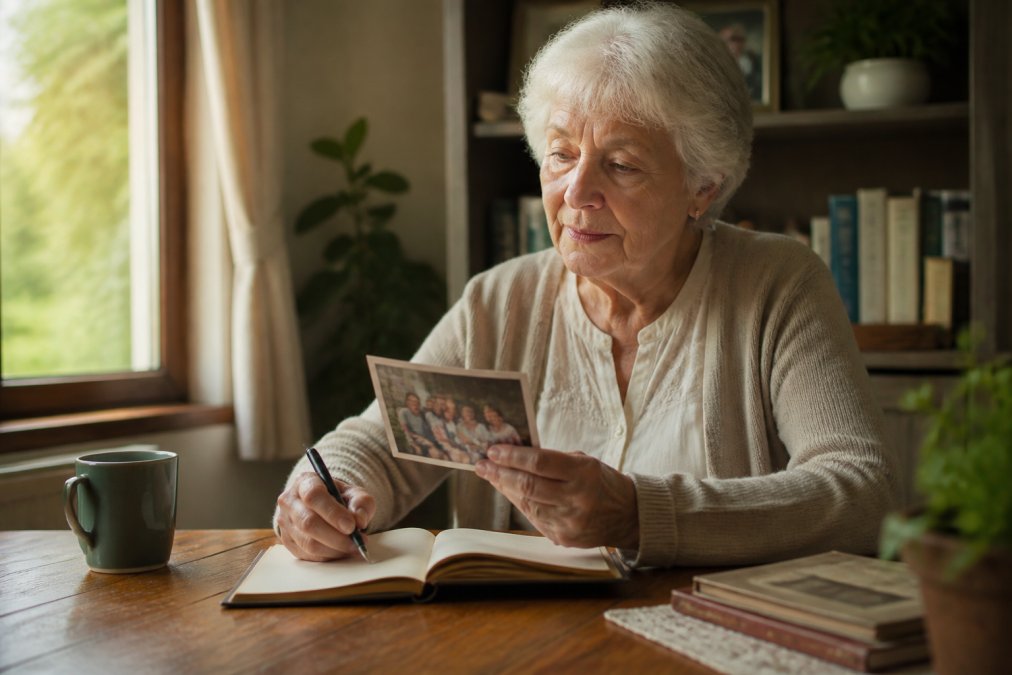
1. What are the earliest memories you have of your childhood home and family?
Childhood memories anchor everything that follows. Describe the physical space, the creaky stairs, the kitchen smell on Sunday mornings, then the people, routines, and rituals. Sensory details make the story vivid.
2. How did your parents or guardians influence the person you became?
This question often produces surprising answers: many people find the traits they resisted in their parents became traits they admire or struggle with themselves. Discuss specific lessons, habits, or sayings, describe the moment you learned them, not generalities.
3. What schools did you attend, and what subjects or teachers shaped your thinking?
Educational attainment is a standard data point, but the real value lies in the stories behind it. Name the schools, subjects you loved, and teachers who changed your trajectory, a single encouraging comment often redirects a life.
4. What was your first job, and what did it teach you about work and responsibility?
Your employment history matters less than what you learned from it. Describe the job, the people, and the moment you understood what responsibility meant. First jobs teach lessons about money, authority, and self-respect that formal education rarely covers.
5. How did you meet your spouse or partner, and what has marriage taught you?
Love stories are the most-read sections of any personal history. Include the practical details, where you were, what you said, then reflect on what the relationship taught you about patience, compromise, or joy. Loss or divorce belongs here too.
6. What challenges or hardships did you face, and how did you overcome them?
Describe the challenge honestly, including the fear and doubt, then explain the steps you took to move forward. The value isn't the triumph; it's the process.
7. What are your proudest accomplishments, personal or professional?
List your professional achievements, but don't stop there. Personal accomplishments often matter more: raising children, maintaining a friendship for decades, learning a new skill at 60. Explain why each matters, not just what you did.
8. What are your most cherished family traditions or holiday memories?
Traditions are the connective tissue of family identity. Describe the specific rituals: the food, the songs, the arguments, the reconciliations. Documenting them ensures they survive even if no one continues them.
9. What life lessons or values do you most want to pass on to future generations?
This is the heart of the document. State your values and explain where they came from. Don't just say "honesty is important", tell the story of the time honesty cost you something, and why you'd choose it again.
10. How do you want to be remembered by your family and community?
This final question asks you to write your own legacy: the person you hope you've been, the impact you hope you've had, the memories you hope people carry. It's the closing chapter your family will return to most often.
Using a Personal History Statement Template to Organize Your Answers
A personal history statement template keeps your answers organized and readable; without one, even thoughtful responses become a jumble of disconnected memories. But the template you choose depends on the document's purpose, the mistake most people make is forcing one template to serve two very different jobs.
There are two distinct genres hiding behind the same phrase:
- The legacy personal history. A narrative document for family, often 20-100 pages, organized chronologically with thematic sections. Its value is emotional and archival.
- The professional personal history statement. A structured disclosure packet used in hiring and background investigations, most visibly for federal law enforcement, civil service, and security clearance processes. Its value is completeness and verifiability.
If you are writing for family, a chronological template works well. Group your answers by life stage: childhood, education, career, relationships, and reflections. This mirrors how biography and genealogy professionals organize life history documents.
If you are completing a professional personal history statement, the template is not yours to redesign. Agencies expect specific categories, in a specific order, with dates in a specific format. The U.S. Office of Personnel Management publishes the standard background investigation forms most federal agencies build on; adapting a family template will leave gaps that delay or disqualify an application.
A robust template, one that can be adapted to either purpose, typically includes:
- Biographical data section: Full name, birth date, birthplace, parents' names
- Residency verification section: Every address you've lived at, with dates. For professional packets, expect to account for the past 5-10 years with month-and-year precision and to name a verifiable contact for each address.
- Education section: Schools attended, degrees earned, certifications obtained, and dates of attendance
- Employment verification section: Every job held, with dates, responsibilities, supervisor names, and reasons for leaving
- Military service section: Branch, dates of service, discharge details if applicable
- Family section: Spouse, children, grandchildren, and other household members
- Legal and financial disclosures: Criminal record, civil judgments, delinquent debt, and tax filing status, required in professional packets, optional in legacy documents
- References section: People who can vouch for your character and work history, with current contact information
- Reflections section: The 10 questions above, answered in full
How to customize without breaking the structure. Treat the template as a checklist of categories, not a script. For a job application, expand the employment and legal sections and compress the reflections; for a family legacy document, do the reverse. Build one master file with every category filled in, then export a trimmed version for each audience.
The National Archives' guidance on personal records preservation recommends keeping both a digital and physical copy of any life history document, since digital formats become obsolete faster than paper. The same advice applies to professional packets: keep a scanned copy of every version you submit, because you may be asked to reconcile discrepancies years later.
Life Story Writing Prompts to Go Beyond the Basics
Life story writing prompts push you past the surface-level answers that make personal histories feel generic. The 10 questions cover the essentials; prompts dig into the details that make your story unmistakably yours.
Try these when you're stuck:
- What did your childhood bedroom smell like?
- What was the first album or song you bought with your own money?
- Who was your best friend at age 10, and what happened to them?
- What's the most scared you've ever been?
- What's a small decision that changed the course of your life?
- What did your grandparents' hands look like?
- What's a family recipe that no one makes anymore?
The Smithsonian's oral history guidelines emphasize that specific sensory details are what make personal narratives memorable. "We had a good childhood" means nothing. "We ate tomato sandwiches on the porch every August" means everything.
How Long Should a Personal History Document Be?
A personal history document should be as long as it needs to be to tell your story completely, but most fall between 20 and 100 pages. There's no standard length, and longer isn't automatically better. A focused 30-page document that answers the 10 questions with specific stories beats a rambling 200-page manuscript. Your family wants clarity, not volume.
For a structured approach, aim for:
| Document Type | Typical Length | Best For |
|---|---|---|
| Short-form legacy letter | 2-5 pages | Readers who want a quick, heartfelt summary |
| Standard personal history | 20-50 pages | Most families; balances detail with readability |
| Comprehensive life story | 50-100+ pages | Detailed genealogy projects; archival purposes |
| Guided course output | Varies by module | Structured reflection with prompts and templates |
If you're using a guided program like My Living Legacy Course, the seven modules and 420+ reflective prompts help you capture your narrative at your own pace, creating a meaningful legacy.
Common Pitfalls to Avoid When Writing Your Personal History
The biggest mistake is waiting for the perfect moment to start. That moment never arrives. Begin with one question, one memory, one paragraph.
Other pitfalls that derail personal history projects:
Writing for an audience instead of yourself. If you're worried what your children will think, you'll self-censor. Write the truth first; decide later what to share.
Skipping the hard stories. The challenges, failures, and regrets are often the most valuable parts. They show future generations that struggle is normal and survivable.
Ignoring digital privacy and security. If you're storing your personal history document online, use a password-protected file or a reputable platform. The Federal Trade Commission's guidance on protecting personal information recommends limiting access to sensitive documents and being cautious about cloud storage for highly personal content. If your document includes Social Security numbers, financial account details, or medical history, consider keeping those in a separate, encrypted file rather than in the narrative itself.
Treating it as a one-time project. Your story isn't finished. Plan to update your document annually, adding new memories and revising old ones.
Confusing standardization with personalization. Templates and prompts are starting points, not straitjackets. The structure helps you organize; your voice is what makes it worth reading.
What a Red-Flag Answer Looks Like in a Professional Context
If your personal history document is headed to an employer, a licensing board, or a background investigator, the stakes change. Most guides on this topic are government forms that tell you what to disclose but not how a reviewer reads it.
A red flag is rarely a single fact, it is a pattern of inconsistency, omission, or evasion. Reviewers look for gaps and contradictions more than the underlying events themselves. Common examples:
- Unexplained gaps in employment or residency. A six-month gap is not automatically disqualifying, but an unexplained one invites scrutiny. If you were between jobs, caring for a family member, or traveling, say so plainly and give dates.
- Addresses or jobs that don't match other records. If your résumé says one thing and your personal history statement says another, investigators will notice. Reconcile your dates before you submit, not after.
- Vague answers to direct questions. "I don't recall" repeated across multiple questions reads as evasive. If you genuinely don't remember a date, say so and give your best estimate with a note that it is an estimate.
- Undisclosed arrests, citations, or civil judgments. Many people assume minor incidents "fall off" the record or don't need to be mentioned. Disclosure requirements are usually broader than criminal convictions, they often include arrests, citations, and non-criminal violations. When in doubt, disclose and explain.
- Financial patterns that suggest instability. Repeated collections accounts, recent bankruptcies, or unpaid judgments are not automatic bars, but they are reviewed. A short, factual explanation of the circumstances and what changed is far stronger than silence.
- Social media that contradicts the written record. Public posts about travel, employment, or activities that conflict with your stated history are easy for an investigator to find.
The one rule that covers most of these: disclose first, explain second, and never make an investigator discover something you could have told them. A disclosed incident with context is almost always less damaging than an undisclosed one that surfaces later.
Frequently Asked Questions
What should be included in a personal history document for family?
A personal history document for family should include your childhood memories, family background, education, career, marriage and relationships, challenges overcome, proudest accomplishments, traditions, life lessons, and how you wish to be remembered. These elements give your family a complete picture of your life, values, and the moments that shaped you. Including both joyful and difficult experiences creates a richer, more authentic narrative that future generations will treasure.
How do I start writing my personal history?
Start by choosing a few questions from the list that resonate most with you, such as your earliest memories or your first job. Set aside 15 to 20 minutes to write freely without worrying about grammar or structure. You can use a personal history statement template to organize your thoughts, or simply begin with a notebook and pen. The goal is to capture memories and reflections, not to produce a polished manuscript on the first try.
What is the difference between a personal history statement and a memoir?
A personal history statement is typically a structured document answering specific questions about your life, often used for legacy planning or applications. A memoir is a literary work that focuses on a particular theme or period of your life, written in a narrative style for a broader audience. For family legacy purposes, a personal history document is often more practical because it covers key life details in an organized, accessible format.
How long should a personal history document be?
There is no fixed length. A personal history document can range from a few pages of brief answers to a hundred pages or more of detailed stories. Most family legacy documents fall between 20 and 60 pages, depending on how many questions you answer and how much detail you provide. The most important thing is that your answers are thoughtful and honest, not that they meet a specific word count.
Why is a personal history document important for legacy planning?
A personal history document preserves your memories, values, and life lessons for future generations. It complements legal documents like a will by explaining the personal stories and wishes behind your decisions. Families who receive a personal history often feel more connected and less overwhelmed during difficult times because they have clarity about your life and legacy. It is a gift of understanding that outlasts any material possession.