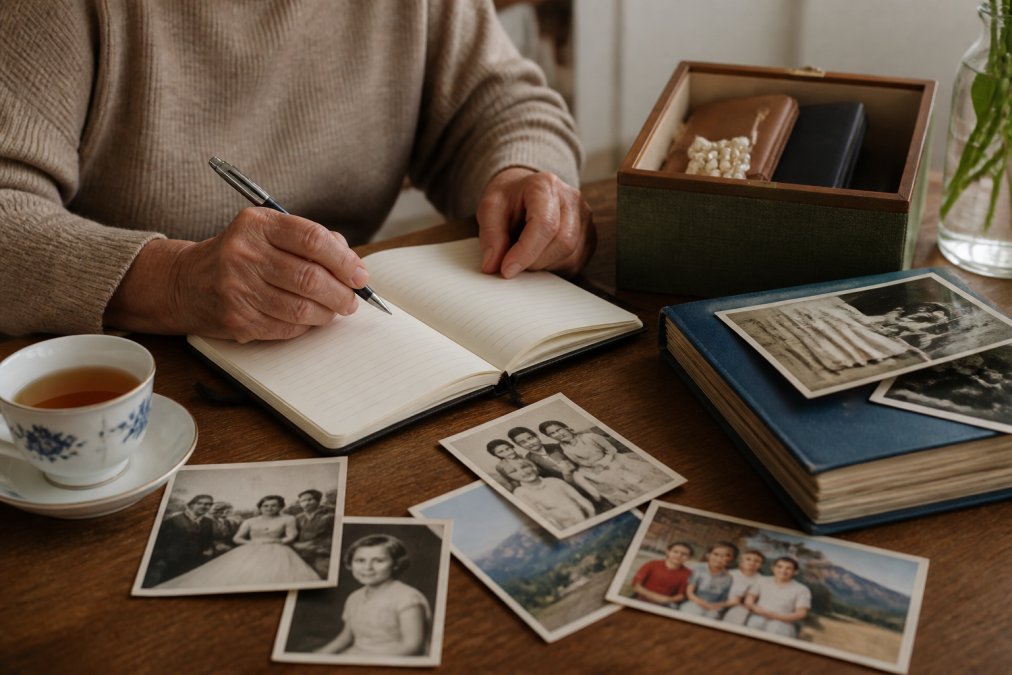
 listicle
Guided Prompts for Life History: 420+ Questions to Document Your Legacy
Table of Contents
- Why Guided Prompts for Life History Matter
- Memoir Writing Prompts for Seniors: Getting Started
- Life Story Interview Questions to Uncover Your Narrative
- How to Write a Memoir in 5 Minutes a Day
- Personal History Writing Templates and Organization
- Thematic Organization: Making Your Legacy Meaningful
- Digital Preservation and Security for Your Life Story
- Writing Your Life History for Specific Audiences
- Frequently Asked Questions
Last Updated: August 8, 2026
Why Guided Prompts for Life History Matter
When someone passes away without documenting their story, families face not just emotional loss but practical chaos: unclear wishes, missing context about decisions, and a sense that something irreplaceable has vanished. The real problem isn't that people don't want to preserve their legacy, it's that they don't know where to start, and the blank page feels paralyzing.
Structured guidance changes everything. Rather than staring at an empty journal wondering what to write, guided prompts for life history give you a framework. They ask the questions you didn't know mattered and trigger memories you'd forgotten. A survey on family communication around end-of-life planning found that many families struggle with uncertainty about their loved ones' wishes, even when legal documents exist. Guided prompts bridge that gap by creating space for the human story that no lawyer can capture in a will.
Memoir Writing Prompts for Seniors: Getting Started
Memoir writing prompts for seniors aren't just creative exercises, they're structured invitations to tell your story in a way that actually gets finished. The difference between "I should write down my memories" and "I'm going to answer these 420 prompts over the next year" is the difference between a good intention and a real legacy.

Starting with memoir writing prompts for seniors means beginning with manageable questions. Not "Write your autobiography" but "What's one meal you remember from childhood that made you happy?" The specificity removes the paralysis that comes with open-ended tasks. Many seniors find that the best prompts trigger sensory memory: What did your grandmother's kitchen smell like? What song was playing when you met your spouse?
My Living Legacy Course organizes its 420+ prompts across seven modules that follow a natural arc through life stages, so your story feels complete rather than fragmented. One common mistake is thinking you need to write perfectly. You don't. These prompts are for your family, not a publisher. Your voice and phrasing are exactly what make it valuable.
Life Story Interview Questions to Uncover Your Narrative
Life story interview questions serve a different purpose than written prompts. When answering questions out loud, you access memories differently, you ramble, digress, and make connections you wouldn't have written down. For people who find writing difficult, life story interview questions are often the better path.
Effective life story interview questions follow a pattern: start broad, then get specific. "Tell me about your childhood" is too open. "What was your favorite hiding spot as a kid, and why did you go there?" is concrete enough to trigger real memory. A comprehensive set typically covers family history, childhood memories, education, career milestones, relationships, travel, major decisions, hobbies, lessons learned, and hopes for how your family will remember you.
Some families use life story interview questions as guided conversations, recording answers on video or audio. Others write them down. The medium matters less than consistency, the goal is to capture your voice and the way you actually tell stories.
How to Write a Memoir in 5 Minutes a Day
The single biggest barrier to completing a memoir isn't lack of material, it's time. But you don't need an hour. Five minutes is enough when you have a prompt to guide you.
Set a Consistent Time and Place
Consistency beats duration every time. Five minutes at the same time each morning, with your coffee, is more powerful than "I'll write whenever I feel like it." Choose a place where you feel comfortable and uninterrupted, a favorite chair by a window or the kitchen table after everyone else has left for the day.
Choose One Prompt and Write Without Editing
Pick one prompt, set a timer for five minutes, and write without stopping. Don't edit, worry about grammar, or cross things out. The goal is to get the memory onto the page. Your internal editor will wake up, resist it. The rough, unpolished version is often more honest and valuable to your family than a polished one.
Five minutes is long enough to answer a single prompt with real detail. Over a year, answering one prompt per day means you'll have completed 365 responses, a substantial legacy.
Personal History Writing Templates and Organization
Personal history writing templates remove the blank-page problem. Instead of starting from nothing, you have structure and categories. This is especially valuable for people who've never thought of themselves as writers.
A good personal history writing template covers major categories: family origins and ancestry, childhood and early memories, education, career and professional achievements, significant relationships, parenting and family building, hobbies and passions, travel, spiritual or philosophical beliefs, and lessons and wisdom.
Some templates are chronological, walking you through your life from birth to now. Others are thematic, grouping memories by topic rather than time. Both approaches work. Chronological feels like a traditional autobiography. Thematic can feel like a collection of stories, which some people find easier to complete.
The templates in My Living Legacy Course's seven modules are designed to work together, building your story in logical order rather than jumping around. This organization also helps your family find information later, they know which section to turn to when looking for your thoughts on a particular topic.
Thematic Organization: Making Your Legacy Meaningful
Thematic organization groups your memories and reflections by meaning rather than chronology. Instead of "everything from 1950-1960," you organize by themes like "what family meant to me" or "lessons I learned the hard way." This works particularly well for people whose lives don't follow a neat linear path.
Many families find that thematic organization makes the legacy more usable. Instead of reading through an entire chronological narrative to understand your values, they can turn to the "values and beliefs" section. The process of organizing thematically also forces you to reflect on what actually mattered. Patterns emerge. Certain values show up again and again. Organizing thematically highlights those patterns, making your core self visible to future readers.
Digital Preservation and Security for Your Life Story
Once you've written your memoir and organized your thoughts, the question becomes: how do you preserve it? Digital preservation and security for your life story is not optional. A handwritten journal can be lost in a fire. A digital file can be lost if the platform shuts down or your password is forgotten.

Digital preservation means thinking about multiple copies. The best approach is the 3-2-1 rule: three copies of your files, on two different types of media, with one copy stored offsite. This might mean a copy on your computer, a copy on an external hard drive, and a copy in cloud storage.
Security means thinking about access and privacy. Who should be able to read your story while you're alive? Should your children have access now, or only after you're gone? Many people use password-protected documents or encrypted files for sensitive information. Others share access with a trusted family member or executor now, so there's no mystery about where the files are or how to access them.
Digital preservation also means thinking about format. A Word document might become unreadable in 20 years as software changes. A PDF is more stable. Some people print their digital memoir and bind it, creating a physical backup that will survive technological changes. A National Archives guide on personal digital preservation recommends regular backups, using standard file formats, and keeping clear records of where your files are stored and how to access them.
Writing Your Life History for Specific Audiences
Your life story might be written for different audiences, and that changes what you emphasize and how you tell it. Are you writing for your grandchildren, who might not remember you in 20 years? Then sensory details and specific stories matter more than abstract lessons. "I worked in accounting" is less valuable than "I worked in accounting, and the thing I loved most was solving puzzles, every tax return was a puzzle to figure out."
Are you writing for your adult children navigating their own major decisions? Then your reflections on how you made choices and what you're proud of become central. Are you writing for extended family or future generations? Then genealogical information matters, where did your family come from, what were the major moves, what stories define your family identity?
Some people write different versions for different audiences. A version for their children that includes personal reflection and advice. A version for grandchildren that emphasizes stories and sensory details. A version for extended family that focuses on genealogy and family history. The prompts in My Living Legacy Course can be answered with different audiences in mind.
Your life story matters. Not because it's dramatic or famous, but because it's yours. The people you love will want to know how you thought, what you valued, and why you made the choices you made. Guided prompts for life history remove the barrier between that intention and reality. They give you structure, permission to write imperfectly, and transform "someday I'll write this down" into something you can actually accomplish.
My Living Legacy Course provides more than 420 reflective prompts organized across seven comprehensive modules, designed specifically to help you capture your narrative at your own pace. It's structured as a companion to your will, addressing the personal, emotional, and practical dimensions that legal documents can't cover. With lifetime access, you can work through your story in five minutes a day, creating a legacy that truly informs and comforts those you cherish.
Frequently Asked Questions
How do I start writing my life history with guided prompts?
Begin by choosing a quiet time when you can focus without distractions. Select one prompt that resonates with you, perhaps a childhood memory or a significant turning point, and write freely without worrying about grammar or structure. Many people find it helpful to set a timer for 5-10 minutes and write continuously. Guided prompts for life history work best when you answer honestly and include sensory details: what you saw, heard, and felt. Don't pressure yourself to complete every prompt; quality reflection matters more than quantity.
What are good life story interview questions to ask myself?
Strong life story interview questions cover key life stages and turning points. Ask yourself: What was your childhood home like? Who influenced you most? What challenges shaped who you became? What accomplishments are you proudest of? What lessons would you want your grandchildren to know? What brings you joy? What would you do differently? These questions encourage deep reflection and help you uncover stories that matter most to your family. Personal history writing templates often organize these questions by life stage, childhood, education, career, relationships, and legacy.
Is it really possible to write a meaningful memoir in just 5 minutes a day?
Yes. Writing a memoir in 5 minutes a day works because consistency beats marathon sessions. A single prompt answered thoughtfully in 5 minutes produces 1,800-2,500 words per year. Over time, these brief reflections accumulate into a substantial life story. The key is removing pressure to be perfect or comprehensive. Short, focused writing sessions help you overcome writer's block and fit documentation into a busy life. Many older adults find this approach less intimidating than trying to write a lengthy memoir all at once.
How do I organize my life history once I've written it?
Personal history writing templates help you organize by chronology, theme, or life stage. Chronological organization follows your birth to present day; thematic organization groups stories by topic (family, career, relationships, values); life-stage organization divides your story into childhood, young adulthood, middle years, and later life. Choose the structure that feels most natural to your story. Digital tools allow you to tag and categorize responses, making it easier to compile sections for family members. Consider which organization method will be most meaningful for the people who will read your legacy.
How do I keep my personal life history safe and accessible to my family after I'm gone?
Digital preservation of your life history requires both security and accessibility. Store your completed responses on a secure platform with password protection, and share login credentials with a trusted family member in a sealed envelope or with your will. Cloud-based solutions offer automatic backup and access from multiple devices. Avoid storing sensitive family information in plain text; redact names or use initials if needed. Consider creating a printed version as a physical keepsake. Discuss with your family how they'll access and share your stories, some families prefer a private digital archive, while others create printed books to distribute.