 how-to
How to Leave a Legacy Beyond Money: 7 Steps
Table of Contents
- What a Legacy Beyond Money Actually Includes
- How to Write an Ethical Will That Heirs Will Treasure
- Tools for Preserving Family History and Oral Stories
- Best Practices for Intergenerational Communication
- How to Leave a Legacy Through Values, Mentorship, and Giving
- Your Digital Legacy: Accounts, Passwords, and Online Memories
- How to Leave a Legacy With a Step-by-Step Legacy Audit
- Conclusion: Start Your Legacy This Week
- Frequently Asked Questions
Last Updated: September 13, 2026
What a Legacy Beyond Money Actually Includes
Learning how to leave a legacy beyond money starts with recognizing that your estate plan covers only part of what you pass down. A legacy beyond money is the stories, values, relationships, and instructions that shape how your family remembers you and moves forward. Families who receive both a legal will and a personal narrative often feel more prepared than those who inherit documents alone.
The American Bar Association's estate planning resources confirm that a will handles asset distribution. It says nothing about why you made the choices you made, what you hoped for your grandchildren, or how you want your family to stay connected.
A complete legacy includes several distinct elements:
- Your ethical will or legacy letter, which communicates values, life lessons, and personal messages
- Family stories and oral histories, which preserve the personal narrative that shaped your family
- Your wishes for relationships, including how you hope siblings, cousins, and extended family will treat one another
- Charitable giving intentions, which express your values through philanthropy and community impact
- Digital assets and online memories, which require their own planning
Most people spend years on financial security and almost no time on the emotional inheritance their family needs.
How to Write an Ethical Will That Heirs Will Treasure
An ethical will passes down your values, beliefs, and life lessons rather than your assets. Unlike a legal will, it has no legal force, its power comes from what it tells your beneficiaries about who you were and what you learned.
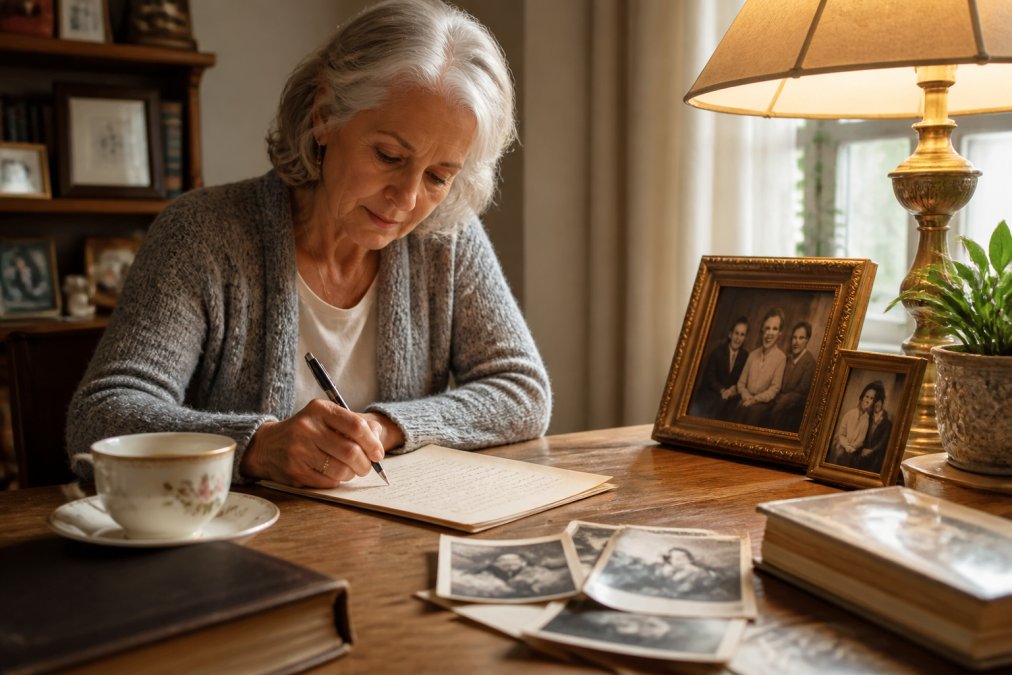
A common mistake is treating an ethical will like a formal legal document. It isn't. Write it in your own voice, the way you'd talk to your children across a kitchen table. Research from the Hospice Foundation of America on advance care planning shows that families who discuss values and wishes openly report less conflict and guilt during difficult transitions.
Start with these prompts:
- What do I want my family to know about how I made my most important decisions?
- Which life lessons took me the longest to learn?
- What do I hope for my grandchildren that I never got to say out loud?
- What family traditions matter most, and why?
- What do I want my family to forgive me for, and what have I forgiven?
Answer honestly. Perfection isn't the goal. Clarity is.
Choosing a Format: Letter, Audio, or Video
The best format is whichever one you'll actually finish. A handwritten letter carries sentimental value heirs keep for decades; an audio recording captures your voice, which many families say they miss most; a video adds facial expressions text can't carry. If you freeze at a blank page, record yourself answering the prompts above on your phone. Many people do both: a letter for the family archive and a short video for those closest to them.
Tools for Preserving Family History and Oral Stories
Preserving family history means capturing stories from living relatives before they're lost. The tools matter less than starting now.
Interview one relative at a time, asking open-ended questions about childhood, work, migration, and turning points. Record it on your phone and label the file with the person's name and date.
For organizing what you collect, consider:
- A shared cloud folder with labeled subfolders by family branch
- A physical binder with printed transcripts and photographs
- A family website or private group where relatives can add their own memories
The Library of Congress oral history guidance offers free interview frameworks that work well for family projects. Their question sets help you move past one-word answers and into the stories that carry real meaning.
Best Practices for Intergenerational Communication
Intergenerational communication works best when you separate the conversation about documents from the conversation about feelings. Most families try to do both at once and do neither well.
Here's what often works:
- Start early and casually. Bring up legacy planning over a meal, not a formal sit-down. "I've been thinking about writing down some family stories" lands better than "We need to talk about my estate."
- Ask before you tell. Ask what your adult children want to know before you launch into what you want to share.
- Use a third-party structure. A guided course or workbook gives everyone a shared framework and removes the pressure of one person driving the conversation.
- Accept that not everyone will engage equally. Some heirs will read every word, others will skim. The document exists for the ones who need it when they need it.
A common mistake is waiting for the "right time." There isn't one. The right time is when you're healthy enough to answer follow-up questions and revise what you've written.
How to Leave a Legacy Through Values, Mentorship, and Giving
Values, mentorship, and charitable giving are the three most durable forms of legacy because they continue operating after you're gone. But durability depends on specificity. "I valued hard work" fades. "I want the family to keep the Sunday dinner tradition, and I want the first grandchild to inherit my toolbox" survives because it attaches a value to an action.
Turning Values Into Instructions
Most people write values as adjectives. Effective values statements read as instructions:
- Weak: "I valued education."
- Strong: "I want the family to fund one trade school or college scholarship per generation from the family fund, and I want the recipient to write a letter to the next recipient explaining what they learned."
The second version tells your heirs what to do, not just what you believed. That is the difference between a sentiment and a legacy.
Mentorship That Outlasts You
Mentorship doesn't require a formal program, just consistency and a mechanism for continuation. One pattern is the "introduction chain": you introduce your mentee to three people who can help them, and ask each to introduce the mentee to three more. A second is the standing commitment: a recurring check-in like a monthly call, annual lunch, or birthday note. Frequency matters less than predictability. People remember who showed up.
Charitable Giving With Real Structure
For charitable giving, work with your attorney or financial advisor to structure gifts through your estate plan. The three most common vehicles:
- Bequests in your will. The simplest option. You name a charity and an amount or percentage. The estate receives a charitable deduction, which can reduce estate tax exposure for larger estates.
- Beneficiary designations on retirement accounts. Retirement accounts passed to individuals are subject to income tax. Naming a charity as beneficiary avoids that income tax entirely, which often makes retirement accounts the most tax-efficient asset to leave to charity.
- Donor-advised funds (DAFs). You contribute during life, take an immediate charitable deduction, and recommend grants over time. A successor advisor, often a child, can continue recommending grants after you're gone, which turns the fund into a multi-generational values tool.
Each vehicle has different tax and administrative implications, so get professional guidance. The IRS publishes the rules in Publication 526 and Publication 590-B, and your advisor can model which combination fits your estate.
The Psychological Impact on Heirs
This is the part most legacy guides skip. Research on inheritance consistently finds that the emotional burden of receiving money without context can be heavier than the money is helpful. Heirs who receive assets with no explanation often report guilt, confusion, or resentment, especially with unequal shares or when the deceased never discussed their intentions.
A short written explanation attached to each gift changes that. "I left the lake house to Sarah because she spent every summer there with me, and I want her children to have the same experience" does more emotional work than any legal document. The explanation converts an asset into a relationship.
Your Digital Legacy: Accounts, Passwords, and Online Memories
Digital legacy management is the step most legacy guides skip entirely, and it causes the most administrative chaos for heirs. Without instructions, your family may spend months accessing accounts, closing subscriptions, and recovering cloud photographs. The problem is legal as well as logistical: most state laws governing digital assets predate cloud storage, and platform terms of service often override what your will says.
The Legal Framework You Need to Know
Most states have adopted some version of the Revised Uniform Fiduciary Access to Digital Assets Act (RUFADAA), which gives a personal representative or trustee authority to access certain digital assets, but only if the user consented in a will, trust, power of attorney, or online tool. Without that consent, platform terms of service usually control, and many platforms deny access to anyone but the original account holder.
The practical takeaway: your will alone is not enough. Name a "digital executor" or authorize your personal representative in a separate document, and use the platform tools that exist.
Platform Tools That Actually Work
Each major platform has its own mechanism. Verify current options before relying on them:
- Apple: Digital Legacy program lets you designate up to five legacy contacts who can access your account data after your death with an access key.
- Google: Inactive Account Manager lets you choose up to 10 people to notify and share data with after a set period of inactivity.
- Facebook: Legacy contact can manage a memorialized profile, but cannot read messages. You can also choose to have the account deleted.
- Instagram: Memorialization only. No legacy contact access to messages.
Set these up now. They take minutes and they are the difference between your family recovering your photos and your family losing them permanently.
What to Inventory
Create a digital asset inventory covering:
- Email, social media, and messaging accounts
- Financial and subscription accounts with recurring charges
- Cloud storage locations for photos, videos, and documents
- Password manager access instructions
- Domain names, websites, or online businesses you own
- Cryptocurrency wallets and their recovery phrases (store these with extreme care)
Store it securely and tell at least one trusted person where to find it. Don't put passwords in your will, it becomes a public document during probate. Use a password manager with an emergency access feature instead.
The Federal Trade Commission's guidance on protecting personal information offers practical steps for securing sensitive data, which apply directly to how you organize and share your digital legacy.
The Emotional Dimension
Digital assets are often the most emotionally charged part of an estate. A parent's text messages, voicemails, and photo library can be the closest thing to hearing their voice again; heirs frequently report that recovering a single voicemail mattered more than any financial bequest.
Your digital plan should note what you want preserved, what you want deleted, and who should have access. A short paragraph in your legacy letter, "I want my photo library shared with all three children, but I want my private journals deleted", prevents years of conflict.
How to Leave a Legacy With a Step-by-Step Legacy Audit
A legacy audit is a structured review of everything you intend to pass down, financial and personal, so nothing important is left unaddressed. Run it once a year or after any major life change.
| Step | What to Review | Time Needed | Frequency |
|---|---|---|---|
| 1 | Legal documents: will, trusts, powers of attorney | 1 hour | Annually |
| 2 | Ethical will or legacy letter | 2-3 hours | Update as needed |
| 3 | Family stories and oral history recordings | Ongoing | Monthly |
| 4 | Digital asset inventory and password access | 45 minutes | Every 6 months |
| 5 | Charitable giving and beneficiary designations | 1 hour | Annually |
| 6 | Conversation with heirs about your wishes | 30-60 minutes | Annually |
The audit isn't about completing everything at once. It's about knowing what exists, what's missing, and what needs updating.
This is where a structured program helps. My Living Legacy Course walks you through seven guided modules and more than 420 reflective prompts, so you're not staring at a blank page. It's designed as a companion to your will, not a replacement. The course captures your personal narrative and final arrangements in one place, and because it's a one-time fee with lifetime access, you can revise your legacy as your life changes.
Conclusion: Start Your Legacy This Week
The hardest part of legacy planning isn't the paperwork. It's deciding that your stories, values, and wishes are worth writing down.
You don't need to finish everything this week. You need to start. Write one page of your ethical will. Record one conversation with a relative. List your online accounts on a single sheet of paper.
My Living Legacy Course gives you the structure to keep going, with seven guided modules, over 420 reflective prompts, and lifetime access so you can work at your own pace. It organizes your story, your wishes, and your final arrangements in one place, giving your loved ones the clarity they'll need when they need it most.
Get started with My Living Legacy Course and give your family the legacy that matters beyond the numbers.
Frequently Asked Questions
What is the best way to leave a legacy beyond money?
Start with a written or recorded ethical will that captures your values, life lessons, and personal stories. Then organize family history, have intentional conversations with younger generations, and document your digital accounts. These steps ensure your heirs receive emotional inheritance and clarity, not just financial assets. Combining these with your existing estate planning creates a complete legacy that supports your family long after you're gone.
How do I write an ethical will?
An ethical will is a personal statement, not a legal document. Begin by listing core values, meaningful memories, and lessons you want to pass on. Write in a letter format to specific heirs or your family as a whole. You can also record audio or video. Keep it honest and warm. Tools like guided journals or courses with reflective prompts can help you structure your thoughts and ensure you cover what matters most.
What tools can help preserve family history for future generations?
Use a combination of digital and physical tools: scanners for old photos, audio recorders for oral history interviews, and online platforms for storing and sharing family trees. Label and date items, and store backups in multiple locations. A guided course can provide structure and prompts to help you capture stories you might otherwise forget. The goal is to make your family's narrative accessible and enduring.
How can I start the conversation about legacy planning with my family?
Begin with open-ended questions about family memories and values, not logistics. Share a story or a value you hold dear, then ask others what matters to them. Use a neutral time, like a family dinner, and keep the tone supportive. Best practices for intergenerational communication include listening more than talking and respecting different comfort levels. Over time, these talks build trust and make deeper planning easier.