 ultimate_guide
Legacy Planning for Aging Parents: A 2026 Guide
Table of Contents
- Why Legacy Planning for Aging Parents Can't Wait
- Essential Legal Documents for Aging Parents
- Estate Planning for Elderly Parents: Trusts, Taxes, and Asset Distribution
- Long-Term Care Planning for Parents: Costs, Insurance, and Incapacity
- Medicaid Planning for Elderly Parents: What Families Need to Know
- How to Start the Legacy Planning Conversation With Your Parents
- Digital Legacy and Password Management: The Gap in Most Legacy Plans
- Beyond the Will: Capturing the Full Legacy Planning Picture for Aging Parents
- Frequently Asked Questions
Last Updated: July 31, 2026
Most families discover too late that a legal will alone cannot carry the full weight of what a parent wants to leave behind. Legacy planning for aging parents is one of the most consequential things a family can tackle together, yet most put it off until a health crisis forces the conversation. The pattern is consistent: families who plan early experience dramatically less conflict, less confusion, and less grief in the aftermath. Below, we'll show you exactly how to build a complete legacy plan, from legal documents to digital passwords to the personal stories that no attorney can capture.
Here's what most guides get wrong: they treat legacy planning as a legal checklist. It isn't. It's a communication strategy. The legal documents matter enormously, but the gap between what parents want and what families understand is rarely a paperwork problem. It's a conversation problem.
Why Legacy Planning for Aging Parents Can't Wait
Waiting is the single most expensive decision a family can make, not just financially, though the costs of dying without a plan can be substantial, but emotionally and relationally.
Legacy planning is the process of organizing and communicating a person's legal wishes, financial assets, personal values, and life story so that loved ones can act clearly and confidently when the time comes. It goes beyond estate planning by capturing the human dimension: the stories, the preferences, the values that no legal document can hold.
The Cost of Waiting: What Families Face Without a Plan
Without a plan, families face probate court, which can delay asset distribution for months or years and expose the estate to unnecessary costs. Siblings dispute what a parent "would have wanted." Medical teams make decisions without guidance. Digital accounts go inaccessible, and sentimental assets get distributed by default rather than intention.
A common mistake is assuming that because a parent is healthy, there's time. Incapacity from a stroke or dementia can arrive without warning, and legal capacity, the ability to sign binding documents, disappears with it. Once that window closes, the options narrow dramatically.
The Difference Between Estate Planning and Legacy Planning
Estate planning focuses on the legal and financial transfer of assets: wills, trusts, beneficiary designations, and tax strategy. Legacy planning is broader. It encompasses personal history, end-of-life choices, values, and the kind of guidance that helps a family grieve and move forward with clarity.
The two are not competitors. They are companions. A will tells your family what they receive. A legacy plan tells them who you were and what you wanted your life to mean.
Essential Legal Documents for Aging Parents
Every complete plan for aging parents rests on a foundation of four core legal documents. Missing any one of them creates a gap that courts, hospitals, or financial institutions will fill on your behalf, rarely in the way you'd choose.
Last Will and Testament and Executor of Estate
A last will and testament is a legally binding document that specifies how a person's assets should be distributed after death and names an executor of estate to carry out those instructions. Without one, state intestacy laws determine distribution, which often doesn't reflect the deceased's actual wishes.
The executor carries a fiduciary duty: a legal obligation to act in the best interests of the estate and its beneficiaries. Choose someone organized, trustworthy, and willing to serve.
Durable Power of Attorney and Healthcare Proxy
A durable power of attorney grants a designated person the legal authority to manage financial affairs if the parent becomes incapacitated. "Durable" means it remains in effect even after incapacity, which is precisely when it's needed most.
A healthcare proxy, also called a medical proxy, designates someone to make medical decisions when the parent cannot. This person should know the parent's values, not just their preferences, because medical situations rarely match the exact scenarios discussed in advance.
According to the American Bar Association's guidance on advance planning documents, these documents are among the most important legal instruments an adult can execute, yet a significant portion of Americans over 65 still lack them.
Living Wills, Advance Healthcare Directives, and Guardianship
A living will is a written statement of a person's wishes regarding medical treatment when they can no longer communicate. An advance healthcare directive is a broader term that often combines the living will with the healthcare proxy designation into a single document.
These documents address end-of-life choices directly: resuscitation preferences, mechanical ventilation, artificial nutrition, and comfort-only care. Without them, medical teams default to aggressive intervention, which is often the opposite of what patients want.
Guardianship is a court-appointed arrangement for individuals who become incapacitated without a valid power of attorney in place. It's the outcome families want to avoid, because it removes decision-making authority from the family and places it with the court system.
Estate Planning for Elderly Parents: Trusts, Taxes, and Asset Distribution
The legal documents above address decision-making during life. This section addresses what happens to assets after death, and how to structure ownership to minimize cost, delay, and conflict.
How a Living Trust Helps With Probate Avoidance
A living trust is a legal arrangement in which a trustee holds assets on behalf of beneficiaries, with the grantor typically serving as their own trustee during their lifetime. The critical advantage: assets held in a living trust pass directly to beneficiaries without going through probate court.
Probate avoidance is not just about speed, though avoiding a process that can take a year or more is significant. It's also about privacy. Probate is public record. A trust is not. For families who value discretion, or who have complex family dynamics, a trust provides a layer of protection that a will alone cannot.
| Document | Primary Purpose | Avoids Probate | Requires Attorney |
|---|---|---|---|
| Last Will and Testament | Asset distribution after death | No | Recommended |
| Revocable Living Trust | Asset management and transfer | Yes | Yes |
| Durable Power of Attorney | Financial decisions during incapacity | N/A | Recommended |
| Advance Healthcare Directive | Medical decisions during incapacity | N/A | Varies by state |
| Beneficiary Designation | Direct transfer of specific accounts | Yes | No |
Beneficiary Designations, Gifting Strategies, and Estate Tax Liability
Beneficiary designations on retirement accounts, life insurance policies, and transfer-on-death accounts override whatever a will says. This is one of the most overlooked issues in estate planning for elderly parents. An outdated beneficiary designation can redirect assets in ways the parent never intended.
Estate tax liability applies to estates above the federal exemption threshold. As documented in IRS guidance on estate and gift taxes, the exemption amount is subject to legislative change, so families with larger estates should work with a tax professional to model their exposure. Gifting strategies, including annual exclusion gifts and charitable giving, can reduce the taxable estate over time.
Long-Term Care Planning for Parents: Costs, Insurance, and Incapacity
This is where legacy planning for aging parents gets financially serious. Long-term care is the category of expense that can deplete a lifetime of savings in a matter of years.
Long-Term Care Insurance and Nursing Home Costs
Long-term care insurance covers services that Medicare typically does not: extended nursing home stays, assisted living, and in-home care. Many families assume Medicare covers these costs. It does not, except in very limited circumstances following a qualifying hospital stay.
According to the U.S. Department of Health and Human Services long-term care cost data, the majority of Americans who reach age 65 will need some form of long-term care during their lifetime. Nursing home costs vary significantly by region, but they represent a major financial exposure for families without a plan.
Incapacity planning, the legal and financial preparation for a period when a parent can no longer manage their own affairs, should be paired with a realistic assessment of care costs. Long-term care insurance is one tool. Medicaid planning is another.
The Sandwich Generation Financial Burden
The "sandwich generation" describes adults who are simultaneously supporting aging parents and raising their own children. When parents haven't planned, adult children often absorb costs informally through direct financial support, unpaid caregiving time, and career interruption. Legacy planning for aging parents is, in this context, also a gift to adult children. A clear plan reduces the burden of guessing, deciding under pressure, and managing family conflict while grieving.
Medicaid Planning for Elderly Parents: What Families Need to Know
Medicaid planning is the process of structuring assets and income to qualify for Medicaid coverage of long-term care costs while preserving as much of the estate as possible for heirs. It is legal, widely practiced, and complex enough to require professional guidance.
The core challenge: Medicaid has strict asset limits for eligibility, and the program uses a "look-back period" to review asset transfers made in the years before application. Transfers made to reduce assets and qualify for Medicaid can trigger a penalty period during which Medicaid will not cover care costs.
A common approach is to work with an elder law attorney several years before care is anticipated, when there is still time to implement strategies like irrevocable trusts or compliant gifting. Families who begin this conversation only when a crisis arrives have far fewer options.
Medicaid planning for elderly parents intersects with the broader estate plan. An elder law specialist is worth the additional cost.
How to Start the Legacy Planning Conversation With Your Parents
The documents are important. The conversation is harder.
Many adult children avoid this topic because it feels like planning for a parent's death. Reframe it: you're planning for their life to be honored the way they want. That shift changes the emotional register of the conversation entirely.
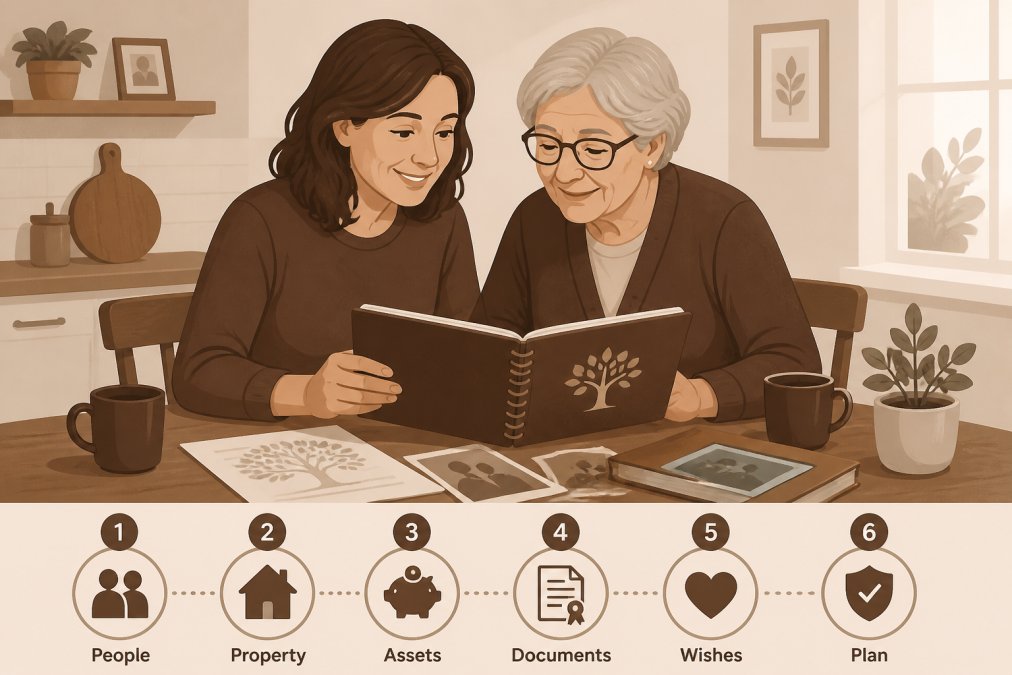
Start with a specific, low-stakes entry point. Ask about a memory, a possession, or a preference rather than opening with "We need to talk about your estate." Once a parent feels heard and not managed, the harder conversations become possible.
Emotional Intelligence and Resolving Family Conflict Around End-of-Life Choices
Family conflict around end-of-life choices is extraordinarily common. Siblings disagree about care decisions. Adult children project their own fears onto a parent's preferences. Old family dynamics resurface under stress.
The most effective approach is to establish the parent's stated wishes in writing before conflict arises, and then treat those documents as the authority. A family meeting, ideally facilitated before any health crisis, can surface disagreements early enough to address them thoughtfully rather than reactively.
Cultural and Religious Considerations in End-of-Life Care
End-of-life choices are not culturally neutral. Preferences around resuscitation, organ donation, burial versus cremation, religious rites, and the presence of clergy at the moment of death vary enormously across cultural and religious traditions.
A culturally competent legacy plan names these preferences explicitly and includes them in the advance directive or a companion document that the healthcare proxy carries.
Digital Legacy and Password Management: The Gap in Most Legacy Plans
Most legacy plans have a significant blind spot: digital assets. Email accounts, social media profiles, online banking, subscription services, cryptocurrency wallets, and cloud storage all require access credentials that die with the account holder unless deliberately transferred.
Digital legacy planning involves three distinct tasks:
- Inventory all digital accounts including financial, social, and subscription platforms
- Document access credentials in a secure, accessible format that a trusted person can reach after death
- Specify wishes for each account whether to memorialize, close, or transfer
A common mistake is storing passwords in a document on the deceased's own computer, which becomes inaccessible without the login credentials. A better approach: use a password manager that allows emergency access designation, or store a printed inventory in the same secure location as legal documents.
Beyond the Will: Capturing the Full Legacy Planning Picture for Aging Parents
Legal documents tell a family what to do. They don't tell them who their parent was.
The most meaningful part of legacy planning for aging parents is often the part attorneys don't handle: the life stories, the values, the lessons learned, the things a parent wants their grandchildren to know decades from now. This transforms the process into something genuinely meaningful.
A structured approach to capturing personal legacy, whether through recorded conversations, written prompts, or a guided course, creates a companion to the legal documents that families return to long after the estate is settled. My Living Legacy Course was built specifically for this purpose: seven guided modules and over 420 reflective prompts help individuals organize their life story, personal wishes, and final arrangements in a format their family can actually use.
The real difference between a legacy plan and a will comes down to this: a will protects assets. A legacy plan protects relationships, memory, and meaning.
Many families complete the legal documents and still leave their loved ones without the clarity they need to grieve well and move forward with confidence. My Living Legacy Course fills that gap with seven comprehensive modules and over 420 reflective prompts designed to help individuals capture their life story, personal wishes, and final arrangements in their own words. With lifetime access for a one-time fee, there's no pressure to rush. Get started with My Living Legacy Course and give your family the gift of genuine clarity alongside the legal plan you've already built.
Frequently Asked Questions
What is legacy planning for aging parents, and how is it different from estate planning?
Estate planning focuses on the legal and financial transfer of assets, documents like a last will and testament, durable power of attorney, and living trust. Legacy planning for aging parents goes further by capturing personal stories, final wishes, values, and practical instructions that legal documents don't cover. Think of estate planning as the legal framework and legacy planning as the human layer that gives your family context, comfort, and clarity beyond what any attorney can document.
When should families begin legacy planning for aging parents?
The best time to start is well before a health crisis forces the conversation. Ideally, legacy planning begins when a parent still has full legal capacity and can make clear, informed decisions. Waiting until incapacity planning becomes urgent, due to illness or cognitive decline, limits options and increases family stress. Starting in a parent's early to mid-seventies, while energy and memory are strong, allows for thoughtful, unhurried decisions about asset distribution, healthcare directives, and personal storytelling.
What legal documents are most important for aging parents to have in place?
At minimum, aging parents should have a last will and testament naming an executor of estate, a durable power of attorney for financial decisions, a healthcare power of attorney or medical proxy, and a living will or advance healthcare directive outlining end-of-life choices. Depending on the size of the estate, a living trust may also be advisable for probate avoidance. An elder law attorney can help ensure all documents meet your state's requirements and reflect current wishes.
How do I bring up legacy planning with a parent who doesn't want to talk about it?
Frame the conversation around love and relief rather than death. Many adult children find it helpful to share a personal story, perhaps a friend's family who struggled after a loss, to open the door naturally. A family meeting with a neutral facilitator, such as a financial planner or counselor, can ease tension. Starting with practical topics like digital assets or beneficiary designations is often less emotionally charged than wills, and can build momentum for deeper legacy planning conversations over time.
What are digital assets, and why do they matter in legacy planning for aging parents?
Digital assets include email accounts, social media profiles, online banking logins, subscription services, digital photo libraries, and cryptocurrency. Without a documented digital legacy plan, including a secure password manager or written inventory, families often lose access to accounts permanently or face months of legal hurdles. Including digital assets in legacy planning ensures a trustee or executor can locate, access, and manage these accounts, and that sentimental digital content like photos and videos isn't lost forever.
How does Medicaid planning fit into long-term care planning for elderly parents?
Medicaid planning for elderly parents involves structuring assets so a parent can qualify for Medicaid benefits to help cover nursing home costs without depleting the family's finances entirely. Because Medicaid has a five-year look-back period on asset transfers, planning must begin well in advance. Strategies may include irrevocable trusts, gifting strategies within IRS limits, and spending down countable assets on allowable expenses. An elder law attorney who specializes in Medicaid planning is essential for navigating these rules correctly.
I already have a will, does my parent really need a legacy planning course on top of that?
A will handles asset distribution, but it doesn't tell your family where to find the insurance policies, what your parent's final wishes are for a memorial service, or the stories behind the heirlooms being passed down. Legacy planning for aging parents fills that gap with personal narratives, practical instructions, and emotional context that a legal document simply can't capture. A structured course with guided prompts helps parents organize all of this in one place, reducing the administrative and emotional chaos families face after a loss.