 comparison
Legacy Planning vs Legal Will: What You Actually Need
Table of Contents
- Legacy Planning vs Legal Will: The Core Difference
- What Is a Legal Will and Why It Matters
- What Is Legacy Planning and How It Works
- The Difference Between Will and Trust in Estate Planning
- Why a Will Is Not Enough: The Legacy Gap
- Essential Legacy Planning Strategies for Your Family
- Estate Planning Checklist: Combining Legal Documents and Personal Legacy
- Frequently Asked Questions
Last Updated: August 6, 2026
Legacy Planning vs Legal Will: The Core Difference
A legal will is a binding document that directs how your assets get distributed after you die. A legacy planning approach is broader, it captures your life story, personal values, wishes beyond money, and the context your family needs to understand your decisions. Think of a will as the legal skeleton. Legacy planning is the flesh, blood, and heart that makes sense of it all.
You can have a perfectly drafted will and still leave your family confused. They'll know who gets the house but not why you made that choice. They'll understand the financial distribution but not your deepest values or how you want to be remembered. That gap, between legal clarity and human understanding, is where legacy planning steps in.
My Living Legacy Course guides you through this process with seven comprehensive modules and over 420 reflective prompts designed to help you organize your story, wishes, and final arrangements so your family receives clarity and support beyond what legal documents alone can provide.

What Is a Legal Will and Why It Matters
A legal will is a formal document that specifies how your property, assets, and guardianship decisions will be handled after your death. It names an executor responsible for carrying out your wishes and identifies your beneficiaries. Without a will, your estate goes through intestacy, state law decides who gets what, regardless of your preferences.
A will prevents legal chaos and gives your executor clear direction. However, it tells them what happens, not why. It doesn't explain your thinking, pass down your values, or help them understand your decisions.
A will typically includes naming an executor, designating beneficiaries, naming a guardian for minor children, and specifying bequests or trust arrangements. Most wills must be signed, witnessed, and notarized to be valid. Online legal services like Trust & Will and LegalZoom provide attorney-designed, state-specific documents that meet these requirements. LegalZoom LLC costs range from free to $299, with three plans to choose from: the Basic plan, the Pro plan or the Premium plan. Trust & Will offers a will for $199 for an individual and $299 for married couples.
But they can't explain why you made certain choices or capture the emotional context that transforms a legal document into a meaningful inheritance.
What Is Legacy Planning and How It Works
Legacy planning is the intentional process of documenting your life story, personal values, wishes, and final arrangements in a way that informs and comforts your family. It answers questions a will never addresses: Who are you? What matters most to you? How do you want to be remembered?
Legacy planning typically includes organizing your personal narrative, clarifying your values, documenting practical wishes (funeral preferences, medical decisions, digital assets), creating letters for specific people or occasions, and leaving instructions for your executor that go beyond the legal minimum.
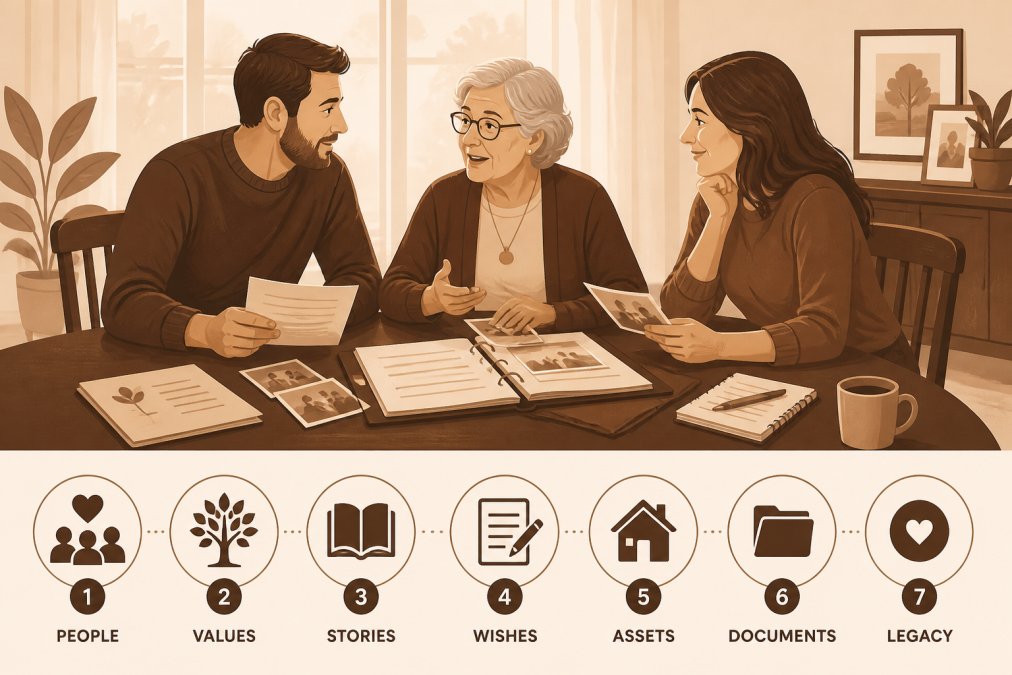
A will is transactional, about legal compliance and asset distribution. Legacy planning is relational, about connection, understanding, and meaning. You're answering not just "who gets what" but "who am I, and what do I want you to know about me?"
My Living Legacy Course structures this work through seven guided modules with 420+ reflective prompts designed to help you think deeply about what matters. With lifetime access, you work at your own pace, capturing your narrative when ready and creating a meaningful legacy that informs and comforts those you cherish.
The prompts guide you through practical territory (financial information, digital assets, funeral preferences) and personal territory (your proudest moments, regrets, advice for your children, hopes for their futures). This combination, practical clarity plus personal meaning, is what legacy planning provides that a will alone cannot.
The Difference Between Will and Trust in Estate Planning
Many people use "will" and "trust" interchangeably, but they're distinct tools serving different purposes in estate planning.
A will is a legal document that takes effect after you die. It directs asset distribution, names an executor, and specifies guardianship for minor children. The will goes through probate, a court process that validates the document, pays debts and taxes, and distributes assets. Probate is public, can be slow, and costs money. But wills are simple to create and update.
A trust is a legal arrangement that holds assets during your lifetime and after your death. You transfer assets into the trust, and a trustee manages them according to your instructions. A revocable living trust can be changed while you're alive; an irrevocable trust cannot. Trusts avoid probate, remain private, and provide more control over asset distribution.
A will is a document; a trust is an arrangement that holds property. Many people have both, a will handles assets not transferred into a trust, while a trust handles transferred assets.
For straightforward situations with modest assets and clear beneficiaries, a will may suffice. For complex situations with significant assets or concerns about beneficiary management, a trust becomes valuable. Services like Quicken WillMaker & Trust and Rocket Lawyer's subscription model help you determine which approach fits your situation. Quicken WillMaker & Trust has a flat price of $99 or an annual subscription of approximately $109. Rocket Lawyer offers a monthly subscription for $39.99 or an annual subscription for $239.88.
Neither a will nor a trust addresses the non-legal dimensions of estate planning or helps you communicate your values to your family. That's where legacy planning fills the gap.
Why a Will Is Not Enough: The Legacy Gap
A will solves one problem: legal distribution of assets. It doesn't solve the human problems that often matter more to families than money.
Consider a parent who leaves the house to one child and cash to another. The will is clear and legal, but the child who received cash feels hurt, was she less loved? The child with the house feels burdened, he never wanted it. The parent never explained that the house required expensive repairs and the cash was meant to help him start fresh.
Or consider digital assets. Your will says nothing about passwords to email, social media, cryptocurrency, or cloud storage. Your executor can't access them. Your family loses photos, documents, or financial records.
This is the legacy gap: the space between legal documents and human meaning. A will handles the legal side but not the relational side. It doesn't communicate your values, reasoning, or hopes for your family's future.
Legacy planning strategies address this gap directly by documenting your life story, values, and wishes in personal, narrative form. You explain your decisions, pass down your values, and leave behind something more than property, you leave behind yourself.
Essential Legacy Planning Strategies for Your Family
Building a complete legacy requires multiple strategies working together.
Document your life story. Write or record the narrative of your life, where you came from, what shaped you, relationships that mattered, experiences that defined you. Tell the stories your children should know and explain the choices you made and why.
Clarify your values. What matters most to you? What do you want your children to prioritize? What principles guided your decisions? Make these explicit rather than assuming your family knows.
Organize practical information. Document financial accounts, insurance policies, property deeds, and passwords. Create a comprehensive inventory of digital assets and who should manage them. Write down preferences for end-of-life care, funeral arrangements, and organ donation. Include contact information for professionals who help manage your affairs.
Create letters for specific people or occasions. Write letters to children, grandchildren, or close friends. Write letters to be opened at specific milestones or difficult anniversaries. These letters provide personal connection that documents cannot.
Address digital assets explicitly. List social media accounts, email addresses, cloud storage, cryptocurrency, and online banking. Provide instructions for what should happen to each. Make these decisions explicit and communicate them clearly.
Communicate with your family while you're alive. Have conversations about your values, wishes, and reasoning. Explain major decisions before they become surprises. This prevents conflict and gives your family a chance to ask questions.
My Living Legacy Course structures these strategies through seven guided modules with 420+ reflective prompts. With lifetime access, you work at your own pace, refining your legacy over time as circumstances change.
Estate Planning Checklist: Combining Legal Documents and Personal Legacy
Creating a complete estate plan requires both legal documents and personal legacy work. Use this checklist to ensure you've covered all the bases.
| Task | Legal Document | Legacy Planning | Priority |
|---|---|---|---|
| Asset distribution | Will or Trust | Family discussion | High |
| Guardian for minors | Will | Values conversation | High |
| Medical decisions | Healthcare directive | Personal wishes letter | High |
| Financial power of attorney | POA document | Instructions for executor | High |
| Digital asset management | Digital inventory list | Passwords and access instructions | Medium |
| Life story documentation | N/A | Written narrative or recording | Medium |
| Values and principles | N/A | Letter or recorded message | Medium |
| Funeral preferences | N/A | Written instructions | Medium |
| Letters to loved ones | N/A | Personal letters | Low |
| Charitable giving intentions | Will or trust | Values alignment explanation | Medium |
Start with legal documents. If you don't have a will, create one. Services like Trust & Will provide attorney-designed documents valid in all 50 states. LegalZoom offers similar options. For complex situations with significant assets or concerns about beneficiary management, consider a trust. Rocket Lawyer's subscription model provides access to attorneys who can help you determine what you need.
Then add legacy planning. A legal document handles the technical side; legacy planning handles the human side. Document your life story, clarify your values, organize practical information, and create personal letters.
Update both regularly. Review your will every 3-5 years or after major life events. Update your legacy documentation as circumstances shift. These should be living documents that reflect your current wishes.
Building a meaningful legacy means doing more than checking boxes on a legal form. It means taking time to reflect on who you are, what matters to you, and what you want your family to understand about your life. My Living Legacy Course provides the structure and guidance to do this work thoughtfully, with lifetime access to return to your legacy as your life unfolds. By combining the legal clarity of a will with the personal meaning of legacy planning, you give your family both the practical information they need and the emotional context that transforms inheritance into understanding.
Frequently Asked Questions
Do I need estate planning or just a will?
A will alone addresses only legal asset distribution and guardianship decisions. Estate planning is broader, it includes wills, trusts, healthcare directives, powers of attorney, and tax strategies. Legacy planning goes further still, capturing your personal stories, values, and non-legal wishes. Most families benefit from all three: a legal will for probate clarity, estate planning for tax and asset protection, and legacy planning to help heirs understand your values and final arrangements beyond what documents alone can convey.
What is the biggest mistake people make with wills?
The biggest mistake is treating a will as the complete solution. Many people create a will and assume their family will understand everything needed during probate and grief. Wills don't explain your reasoning, your personal stories, digital asset locations, or how you want to be remembered. This leaves heirs confused, stressed, and sometimes making decisions that conflict with your actual wishes. Adding legacy planning, documenting your values, stories, and specific instructions, prevents this gap.
Does a will cover legacy planning?
No. A will is a legal document that directs asset distribution and names guardians. Legacy planning is the process of documenting your life story, values, personal wishes, and final arrangements in a way that comforts and guides your family. A will might say 'give the house to my daughter,' but legacy planning explains why that matters to you, shares memories tied to the house, and provides instructions for things a will cannot address, like digital assets, family recipes, or how you want to be remembered.
What is the primary goal of legacy planning?
The primary goal is to create clarity and comfort for your loved ones during and after your lifetime. Legacy planning ensures your family understands your values, knows where important documents are, understands your final wishes beyond legal requirements, and feels connected to your life story. It reduces confusion during probate, prevents family conflict over non-legal decisions, and gives heirs the personal guidance they need to honor your wishes and carry forward what matters most to you.