 listicle
Memoir Writing Course Review: 9 Best for Beginners
Table of Contents
- How We Evaluated the Best Memoir Writing Courses
- Quick Comparison: Top Memoir Writing Course Review Picks
- 1. My Living Legacy Course: Best for Legacy Planning and Memoir Writing
- 2. Gotham Writers Workshop: Best for Structured Feedback
- 3. The Memoir Writing Club: Best for Community Support
- 4. Marion Roach Smith's Classes: Best for Learning from an Author
- What to Look For in a Memoir Course for Beginners
- Using Memoir Writing Prompts for Beginners to Get Started
- How Long Does It Take to Write a Memoir? Setting Realistic Goals
- Frequently Asked Questions
Last Updated: September 8, 2026
How We Evaluated the Best Memoir Writing Courses
A memoir writing course review for beginners should measure more than just curriculum quality. We evaluated each option against five criteria: instructor expertise, feedback mechanisms, time commitment, cost transparency, and the practical outcome you can expect. The truth is that most memoir courses teach the same fundamentals; they differ in how much guidance and accountability you receive.
For this memoir writing course review, we also considered the emotional reality of the task. Writing about your life requires vulnerability, and the best courses create a safe container for that work. We prioritized programs with clear structure, responsive instructors, and a defined path from memory to manuscript.
Quick Comparison: Top Memoir Writing Course Review Picks
| Course | Format | Best For | Standout Feature |
|---|---|---|---|
| My Living Legacy Course | Self-paced, 7 modules | Legacy planning and family storytelling | 420+ reflective prompts |
| Gotham Writers Workshop | 10-week workshop | Structured feedback | Peer critique groups |
| The Memoir Writing Club | 12-week interactive | Community support | Live sessions |
| Marion Roach Smith | Self-paced + live Q&A | Learning from an author | Direct expert access |
| Brooke Warner | 4 sessions | Budget-conscious writers | Focus on structure |
1. My Living Legacy Course: Best for Legacy Planning and Memoir Writing
For most beginners, the purpose of writing a memoir extends beyond publication. You want your children and grandchildren to know who you were, what mattered to you, and how you navigated life. My Living Legacy Course addresses this directly through seven guided modules and over 420 reflective prompts that walk you through your story, wishes, and final arrangements.
The course functions as a companion to your will, capturing the personal narrative that legal documents cannot express. Lifetime access means you can work at your own pace, returning to refine memories as they surface. For older adults who want their families to receive clarity and comfort, this is a comprehensive option.
2. Gotham Writers Workshop: Best for Structured Feedback
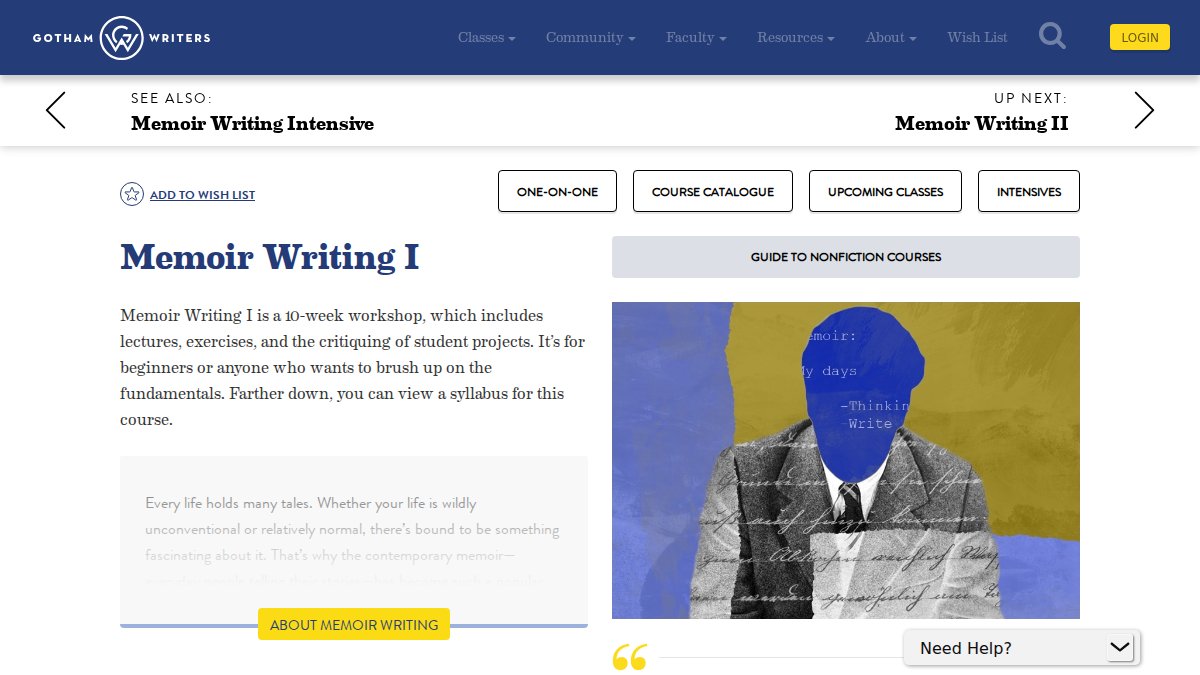
Gotham Writers Workshop offers a structured 10-week memoir writing course for beginners who want a traditional classroom experience. Weekly lectures cover memoir fundamentals, while guided writing exercises build your skills incrementally. The defining feature is peer-based project critiquing, which provides the accountability many writers need.
The main drawback is the significant time commitment. A 10-week workshop demands consistent attendance and weekly writing output, which may feel overwhelming if you are balancing other responsibilities. However, the direct feedback from instructors and classmates accelerates improvement in ways that self-study cannot replicate.
3. The Memoir Writing Club: Best for Community Support
The Memoir Writing Club takes a 12-week interactive approach focused on memory triggering and creative nurturing. Weekly modules include live sessions where you connect with fellow memoirists who understand the emotional weight of autobiographical writing. The writing prompts are designed specifically to unlock buried memories.
This course excels for writers who thrive on connection. The community-based support structure keeps you motivated when the writing becomes difficult. The tradeoff is duration: 12 weeks is a long commitment, and those seeking quicker results may find the pace slow.
4. Marion Roach Smith's Classes: Best for Learning from an Author
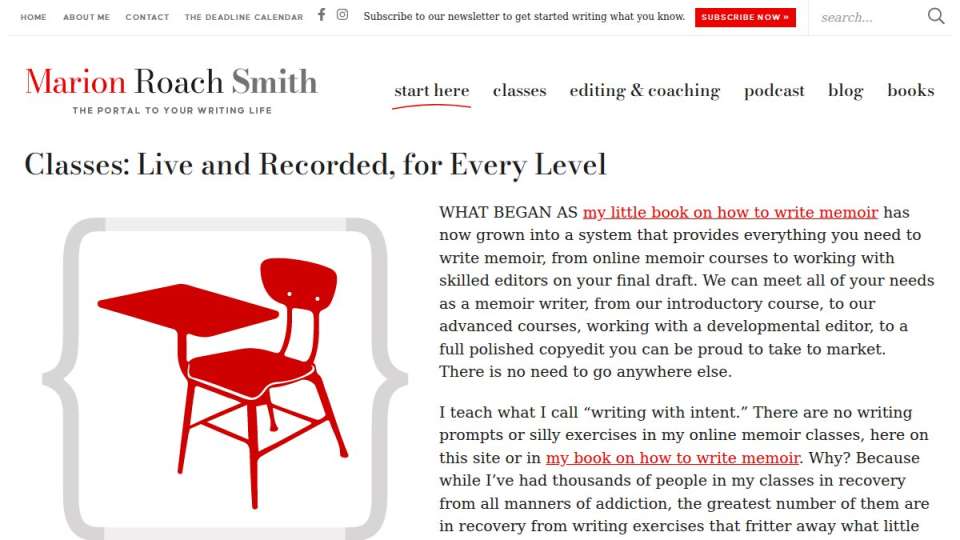
Marion Roach Smith brings decades of professional memoir experience to her online classes. Her memoir writing course for beginners focuses on foundational principles, offering actionable tools you can apply immediately. Live Q&A sessions provide direct access to her expertise, allowing you to ask questions specific to your story.
The limitation is enrollment windows. Classes open only at specific times, so you may wait months before starting. If you prefer learning directly from an established author who has navigated the publishing industry, this is a strong choice.
Other Notable Courses for Beginners
Several additional options deserve mention. Brooke Warner's Mastering Structure offers a concise four-session format at an accessible price point, ideal for writers who need help organizing their narrative arc. Sarah Lawrence College provides a five-week in-person workshop for those who value face-to-face accountability. Udemy and Domestika host affordable self-paced video courses, though they lack personalized feedback. For serious writers, Faber Academy runs a comprehensive six-month program with publishing industry access. Reedsy's directory of vetted memoir writing classes can help you compare these options side by side.
What to Look For in a Memoir Course for Beginners
Most reviews tell you what they liked. A smarter approach is to arm yourself with a checklist so you can evaluate any course you find, regardless of which platform hosts it. The right course for you depends on your goals, your schedule, and your comfort with technology. Here is an objective rubric to apply to any memoir writing course for beginners.
The 7-Point Course Evaluation Rubric
1. Instructor Credentials and Teaching Style
Look beyond the author bio. Does the instructor have a track record of teaching beginners, not just writing? Check for sample lectures or free previews. A great memoirist is not automatically a great teacher. Look for instructors who break down the craft into digestible lessons and offer concrete examples of before-and-after revisions.
2. Feedback Mechanism and Its Specificity
What kind of feedback will you receive on your writing? Peer review is common, but its quality varies wildly. Ask if the course provides structured critique guidelines for peers. Instructor feedback is more valuable but often limited. Determine if feedback is written, audio, or video, and how many times you can submit work for review.
3. Curriculum Structure and Progression
Does the course have a clear arc from memory-gathering to structuring a narrative? A good syllabus moves from prompts and free-writing to scene-building, narrative structure, and revision. Avoid courses that are just a collection of prompts without a logical sequence. Look for a defined path from raw memory to a coherent manuscript.
4. Time Commitment and Pacing
Be honest about your schedule. A 10-week intensive workshop with weekly deadlines will not work if you have caregiving responsibilities or a demanding job. Self-paced courses offer flexibility but require self-discipline. Check if the course has a defined end date or if you get lifetime access. The best course is the one you can actually finish.
5. Platform Usability and Technical Support
This is a factor most reviews ignore. Before enrolling, check if the course platform is mobile-friendly. Can you download lessons for offline viewing? Is there a community forum that is easy to navigate? For older adults, a clunky interface can be a dealbreaker. Look for courses that offer straightforward technical support via phone or email, not just a help desk ticket.
6. Cost Transparency and Value for Money
Does the price include all materials, or are there upsells for worksheets, additional feedback, or community access? Compare the cost per week of live instruction versus the cost of self-paced video content. A higher price is justified if it includes direct instructor access or a robust feedback system. A lower price is only a bargain if you complete the course.
7. Accessibility and Inclusivity
This is another overlooked factor. If you have a learning disability like ADHD or dyslexia, check if the course offers transcripts for video lessons, or if the reading materials are available in accessible formats. For those with chronic health issues, look for courses that are asynchronous and do not penalize you for missing a live session. A course that accommodates your needs is more likely to keep you engaged.
By using this objective framework, you move beyond anecdotal recommendations and make a decision based on your specific needs. The best memoir writing course for beginners is not the one with the most famous instructor; it is the one that provides the structure, support, and accessibility you need to finish your story.
Using Memoir Writing Prompts for Beginners to Get Started

Memoir writing prompts for beginners serve as the bridge between memory and the page. A good prompt asks a specific question that triggers sensory recall: What did your childhood kitchen smell like on Sunday mornings? What song was playing the first time you danced with your partner? These focused questions bypass the overwhelm of "tell your life story" and produce concrete, vivid material.
The 420+ reflective prompts in My Living Legacy Course are organized to guide you through your narrative systematically, from childhood memories to the values you want to pass down. Working through prompts in sequence creates a coherent manuscript rather than scattered fragments. Set aside 15 minutes daily and let the prompts lead you.
How Long Does It Take to Write a Memoir? Setting Realistic Goals
How long does it take to write a memoir? The honest answer is that it depends entirely on your definition of "done." For a beginner, the timeline shifts dramatically based on whether you are writing for commercial publication or for a personal legacy project. A complete first draft often takes six months to two years of consistent work, but that range hides a more useful breakdown (thecreativepenn.com).
The Two Timelines: Publication vs. Legacy
If your goal is commercial publication, you are not just writing a manuscript; you are entering a multi-year process that includes revision, agent querying, and editorial feedback. The writing itself is only the first step. For a beginner, expect to spend 12 to 24 months on the first draft alone, followed by another 6 to 12 months of revision before you are ready to query agents. This is a professional path that requires a significant investment of time and emotional energy.
If your goal is to leave a legacy document for your family, the timeline is far more compressed and the definition of success is different. You are not aiming for a market-ready manuscript; you are aiming for a truthful, organized account of your life. For this purpose, a structured course with guided prompts can help you complete a meaningful document in as little as three to six months. The ROI here is not financial; it is the clarity and comfort your family receives from knowing your story.
A Realistic Weekly Breakdown for Legacy Writers
For those writing for family, a sustainable pace is more important than intensity. A common pattern that works is:
- Week 1-2: Memory Gathering. Use prompts to list key life events, people, and places. Do not write in full sentences yet; just capture the raw material.
- Week 3-4: Theme Identification. Look for the through-lines in your memories. What values, struggles, or lessons repeat? This becomes your narrative spine.
- Week 5-12: Scene Writing. Write one or two short scenes per week based on your most vivid memories. Focus on sensory details and dialogue.
- Week 13-16: Structuring and Editing. Arrange your scenes in a logical order. Cut what does not serve the theme. Add transitions.
- Week 17-20: Final Polish. Read the document aloud to catch awkward phrasing. Ask a trusted family member to review it for factual accuracy.
This 20-week plan is realistic for a legacy document (legacystories.org). It requires about two to three hours of focused work per week, which is manageable for many adults with busy schedules.
The Cost of Perfectionism
The biggest threat to your timeline is not lack of talent; it is perfectionism. Many beginners get stuck in the first chapter, rewriting the opening paragraph endlessly. A structured course helps you avoid this by setting weekly goals and providing accountability. The goal is not to write a perfect memoir on the first pass; it is to get a complete draft down on paper. You can always revise later. You cannot edit a blank page.
Set a sustainable pace that fits your life. Twenty minutes daily produces more than four hours once a month. Build accountability through a course community or a family member who checks your progress, and celebrate each completed section rather than waiting for the finished manuscript. The goal is not perfection; it is capturing your story while you can tell it clearly. Consistent progress matters more than speed.
Frequently Asked Questions
How do I choose an online memoir writing course that fits my goals?
Start by defining your end goal. If you want to publish a literary memoir for the public, a rigorous workshop like Gotham or Faber Academy offers the critique and craft instruction you need. If your goal is to create a private family keepsake, a guided program like My Living Legacy Course provides 420+ prompts to capture stories and final wishes without the pressure of public readership. Consider your schedule, budget, and whether you need accountability from live sessions or prefer self-paced learning.
What are common memoir mistakes beginners make?
The most frequent mistake is trying to cover an entire life chronologically, which results in a shallow narrative. Instead, focus on a specific theme or period. Beginners also often write for a vague audience; decide if you are writing for the public or your family. Another common error is avoiding vulnerability, which leaves the story flat. Finally, many neglect the editing process, but revision is where the real craft of memoir writing develops.
How long does it take to write a memoir in a course?
Course durations vary widely. A structured course like Gotham's Memoir Writing I runs for 10 weeks, while The Memoir Writing Club takes 12 weeks. For a full manuscript, Faber Academy's program lasts six months. However, the actual writing time depends on your pace and the scope of your project. A self-paced program like My Living Legacy Course allows you to work through the modules over months or even years, making it easier to fit into a busy schedule.
What is the difference between legacy planning and memoir writing?
Memoir writing focuses on crafting a narrative from your life experiences, often with a literary angle and a public audience in mind. Legacy planning is broader, encompassing your personal stories, values, and final wishes for your family. A course like My Living Legacy Course combines both, guiding you to write your life story while also organizing practical information about your arrangements, ensuring your family receives both emotional and administrative clarity.
Do I need a professional editor for my memoir?
You need an editor if you plan to publish your memoir for the public. A professional editor provides an objective perspective on structure, pacing, and prose, which is critical in a competitive publishing industry. For a private family memoir, an editor is optional. You can still benefit from a peer review group to catch inconsistencies and clarify vague passages. If you use a structured course, instructor feedback often serves a similar purpose.