 ultimate-guide
Online Legacy Course for Seniors: What to Look For
Table of Contents
- What an Online Legacy Course for Seniors Actually Covers
- Benefits of Legacy Planning for Older Adults
- Digital Legacy Planning for Seniors: How Online Courses Work
- Ethical Will Writing Course vs. Other Legacy Formats
- Free Online Courses for Seniors vs. Paid Legacy Programs
- How to Choose the Right Online Legacy Course for Seniors
- My Living Legacy Course: An In-Depth Review
- Frequently Asked Questions
Last Updated: August 2, 2026
Choosing the right online legacy course for seniors is not a trivial decision. Most families discover, far too late, that a legal will answers none of the questions that matter most after a loss: where to find the insurance policies, what songs should play at the service, or what a parent most wanted their grandchildren to know about their life. At My Living Legacy Course, we've built a guided program specifically designed to close that gap, and this review breaks down exactly what to look for, what to avoid, and how structured legacy planning actually works in practice.
According to AARP research on family caregiving and end-of-life planning, a significant share of adult children report feeling unprepared to handle a parent's final affairs, not because a will was missing, but because the practical and personal details were never recorded anywhere.
What an Online Legacy Course for Seniors Actually Covers
An online legacy course for seniors is a structured digital program that guides older adults through documenting their life story, personal values, final wishes, and practical household information in a format their family can actually use. The emphasis is on narrative and personal context, not legal enforceability.
How It Differs from a Legal Will
A legal will is a binding document that directs the distribution of assets. A legacy course produces something entirely different: a personal record that answers the questions a will legally cannot. Think of the will as the skeleton of an estate plan. A legacy course adds the flesh, the voice, and the story.
A well-structured legacy program typically covers:
- Location of key documents and accounts
- Funeral and memorial preferences
- Personal values and life lessons to pass forward
- Family history and stories the next generation may never have heard
- Final messages to specific individuals
- Medical preferences and caregiver instructions
None of those items belong in a legal will. All of them cause significant distress when they're missing.
What Families Actually Receive at the End
The output of a legacy course is a personal document, or set of documents, that a family member can open during one of the hardest weeks of their life and find real answers. The best programs produce something a grieving adult child can sit with and feel their parent's presence, not just their asset allocation.
Benefits of Legacy Planning for Older Adults
Structured reflection has measurable benefits that extend well beyond the document itself.
Cognitive Health and Neuroplasticity: Why Structured Reflection Matters
Engaging in autobiographical reflection, particularly when guided by structured prompts, actively exercises the brain's recall and narrative-construction systems. According to National Institute on Aging resources on cognitive health and aging, mentally stimulating activities that involve memory retrieval and storytelling are associated with maintained cognitive function in older adults.
A course built around 420+ reflective prompts is not just a documentation tool. Each prompt is a cognitive exercise that draws on episodic memory, emotional processing, and language production simultaneously.
Social Engagement and Family Connection
Legacy planning done well creates a bridge across generations. Many older adults report that beginning the process opens conversations with adult children that had never happened before. The course becomes a catalyst, not just a product. Isolation is a well-documented risk factor for cognitive decline among older adults, and a course that prompts someone to share memories and write personal messages actively counters that isolation.
Digital Legacy Planning for Seniors: How Online Courses Work
Digital legacy planning for seniors works best when the technology stays out of the way. The course structure should carry the learner forward, not the platform.
Step-by-Step Digital Onboarding for Non-Tech Users
A 72-year-old who hasn't taken an online course before faces a real barrier. Good onboarding for non-tech users includes:
- Account creation in under three steps - no payment portals embedded in sign-up flows
- A clear starting point - the first module should load automatically
- Progress saved automatically - the learner should never lose work
- Text size and contrast options - accessibility is not optional for this demographic
- No time pressure - self-paced learning means the course waits indefinitely
- Simple navigation between modules - forward, back, and a clear sense of progress
For older adults new to virtual classrooms, predictability matters more than a clean interface. The interface should behave the same way every single time.
Accessibility and Adaptive Technology Features to Look For
A genuinely accessible course considers:
- Screen reader compatibility for users with low vision
- Keyboard navigation for users with limited fine motor control
- High-contrast display modes built into the learning management system
- Audio options so prompts can be heard, not just read
- Mobile-friendly design because many older adults primarily use tablets
Ethical Will Writing Course vs. Other Legacy Formats
Not every legacy format serves the same purpose. Understanding the differences prevents you from paying for something that duplicates what you already have.
Ethical Wills, Memoir Prompts, and Final Arrangements: What Each Format Does
| Format | Primary Purpose | Legal Standing | Typical Output |
|---|---|---|---|
| Ethical will writing course | Values, lessons, personal messages | None | Written narrative document |
| Legal will | Asset distribution | Legally binding | Court-filed document |
| Memoir prompts | Life story, family history | None | Personal narrative |
| Advance directive | Medical decisions | Legally binding | Medical instruction form |
| Final arrangements guide | Funeral and practical logistics | None | Instruction document |
| Legacy course (comprehensive) | All non-legal elements combined | None | Multi-section personal record |
An ethical will writing course focuses specifically on transmitting values and wisdom. A comprehensive legacy course covers the ethical will component alongside practical arrangements and life story documentation.
Free Online Courses for Seniors vs. Paid Legacy Programs
Free online courses for seniors exist across many topics, and the legacy planning space is no exception. The question is not whether free options exist, but whether they deliver what a structured, guided program delivers.
Platform Comparison: Features, Depth, and Access
Many free platforms offer individual tools: a document storage vault, a simple prompt list, or a basic memoir template. What they typically lack is the curriculum architecture that moves a learner from starting to finishing.
The honest framework for evaluating free vs. paid:
- Free platforms tend to offer breadth without depth. You get access to many tools but little guidance on how to use them in sequence.
- Paid programs with one-time fees offer a defined curriculum, structured modules, and a clear path from enrollment to a finished document.
- Subscription-based platforms introduce ongoing cost and the risk that the platform discontinues service or changes its terms.
For this demographic, asynchronous, self-paced learning removes the scheduling barrier entirely. That flexibility is often the difference between completing the course and abandoning it.
How to Choose the Right Online Legacy Course for Seniors
The right online legacy course for seniors meets you where you are technically, covers what your family actually needs, and gives you a realistic path to finishing.
Questions to Ask Before You Enroll
Before committing to any program, work through this checklist:
- Does the course cover both personal stories and practical final arrangements, or only one?
- Is access lifetime, or does it expire after a set period?
- Is the pricing a one-time fee or a recurring subscription?
- Can I access the course on a tablet or phone, not just a desktop?
- Are there guided prompts, or am I expected to write from a blank page?
- Is there a clear module structure, or is the content unorganized?
- Does the course produce a shareable output my family can actually use?
- Is there customer support if I get stuck technically?
Red Flags: What Shallow Programs Leave Out
Shallow programs reveal themselves in specific ways:
- Fewer than 50 prompts, which means the output will be superficial
- No module structure, just a collection of downloadable PDFs
- No guidance on final arrangements, only personal stories
- Subscription pricing that creates ongoing financial commitment and platform dependency
- No clear output format, leaving the user uncertain what they're producing
The quality of the prompts determines the quality of the final document. Vague prompts produce vague answers. Specific, thoughtfully sequenced prompts produce something a family will return to for years.
My Living Legacy Course: An In-Depth Review
My Living Legacy Course is a guided online program built around seven comprehensive modules and over 420 reflective prompts, designed to help older adults document their life story, final wishes, and practical arrangements in a single organized resource for their family.
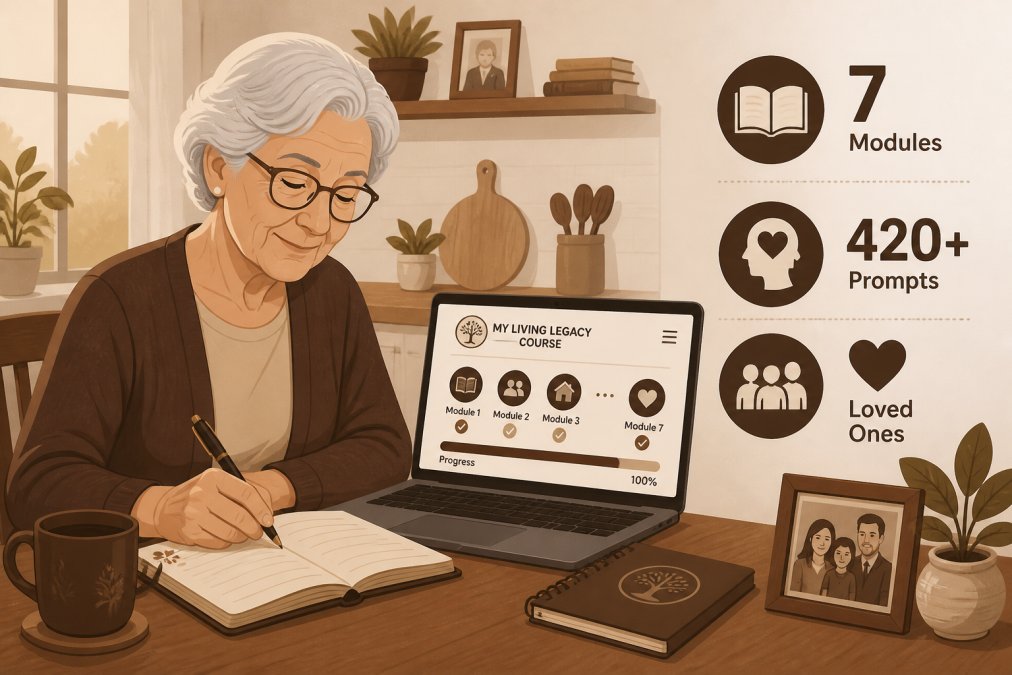
The program functions as a companion to a legal will, not a replacement for one. My Living Legacy Course does not attempt to provide legal advice or replicate what an estate attorney does. It fills the space that a will legally cannot: the personal, the practical, and the human.
Strengths: Structure, Depth, and Lifetime Access
The most significant structural advantage is the combination of module depth and lifetime access. Seven modules covering the full spectrum of legacy documentation give the curriculum enough room to go beyond surface-level prompts. The 420+ prompts are sequenced to move a learner progressively deeper into their own story.
Lifetime access for a one-time fee addresses the two most common objections older adults have about online programs: the fear of being locked into a subscription and the concern that the platform will disappear before they finish. For learners who are not tech-savvy, the self-paced format means there is no deadline pressure and no live session to miss.
Honest Drawbacks to Keep in Mind
My Living Legacy Course is a written, prompt-based curriculum. Learners who prefer video-led instruction or want a live instructor-led experience will find the format less engaging than a webinar or synchronous classroom environment.
The depth of the output also depends on the effort the learner brings. The structure is there. The depth is up to the individual.
Visit the My Living Legacy Course website directly for current pricing information, as the one-time fee structure means costs are confirmed at enrollment.
Who This Course Is Best Suited For
My Living Legacy Course is the right fit for:
- Adults aged 60-80 who have completed a legal will and want a companion resource that covers everything the will does not
- Adult children looking for a meaningful, practical gift that helps an aging parent organize their story and final wishes
- Individuals who recently lost a loved one and experienced firsthand the chaos of missing information
- Proactive planners who value structured guidance over blank-page memoir writing
According to Gerontological Society of America resources on aging and life review, structured life review is recognized as a meaningful psychological and social process for older adults, supporting both well-being and family cohesion. My Living Legacy Course sits squarely within that tradition, with a practical output that families can use.
The challenge most families face is not a lack of love. It is a lack of recorded information. When a parent or grandparent passes without leaving a personal record, the grief is compounded by administrative confusion and unanswered questions that no legal document can resolve. My Living Legacy Course addresses that gap directly, through seven guided modules, 420+ reflective prompts, and lifetime access to a curriculum designed to produce a document your family will genuinely use. Get started with My Living Legacy Course and give your family the clarity they deserve.
Frequently Asked Questions
What is a digital legacy plan for seniors, and how does an online course help?
A digital legacy plan is a structured record of your life story, personal wishes, final arrangements, and messages for loved ones, going well beyond what a legal will covers. An online legacy course for seniors guides you through this process with prompts, modules, and self-paced learning so nothing important is left out. Instead of a blank page, you get a framework that walks you through memories, values, and practical instructions your family will actually need.
How does an ethical will writing course differ from a standard legal will?
A legal will distributes assets and is enforced by probate court. An ethical will writing course focuses on something entirely different: passing down your values, life lessons, personal stories, and emotional wishes. It has no legal standing, but it often means more to families than the legal document. Courses like My Living Legacy Course treat the ethical will as a companion to your attorney-drafted will, filling in the human context that legal language cannot capture.
Are there free online courses for seniors that cover legacy planning?
Some platforms offer free introductory modules on estate organization or memoir writing, but truly comprehensive legacy planning courses are typically paid programs. Free options tend to cover only surface-level prompts or single topics like digital asset lists. Paid courses provide structured curricula, guided reflection modules, and lifetime access to your completed materials. If you want depth, covering final arrangements, personal stories, and family messages, a dedicated paid program is worth comparing against free alternatives.
I'm not very tech-savvy. Will I be able to complete an online legacy course?
Most reputable online legacy courses for seniors are designed specifically for older adults with limited technical experience. Look for programs with simple user interfaces, large text, clear navigation, and self-paced asynchronous learning so there is no pressure to keep up with a live class. My Living Legacy Course is built around accessibility, meaning you work through modules at your own pace without needing prior experience with a learning management system or virtual classroom tools.
What should be included in a legacy plan for older adults?
A thorough legacy plan typically covers your life story and formative memories, personal values and lessons, final wishes beyond legal documents, funeral and burial preferences, location of important records, digital account information, and personal messages to specific family members. A structured online legacy course for seniors walks you through each of these areas with reflective prompts, so nothing critical is forgotten and your family is not left guessing during an already difficult time.