 listicle
What to Include in Legacy Documents: A Complete Checklist
Table of Contents
- What to Include in Legacy Documents
- Personal Identification Documents
- Last Will and Testament
- Financial Accounts and Assets
- Property Deeds and Titles
- Healthcare Directives and Proxy
- Power of Attorney Documents
- Digital Assets and Passwords
- Secure Storage and Accessibility
- Maintenance and Review Schedule
- Frequently Asked Questions
Last Updated: August 7, 2026
What to Include in Legacy Documents
Legacy documents are far more than a will. They're your voice when you can't speak, your instructions when you're gone, and your stories preserved for generations. While a will distributes assets, legacy documents communicate your values, explain your wishes, and provide practical details your family desperately needs during difficult moments. Without them, loved ones face confusion, stress, and costly mistakes.
This guide covers everything you need to include in your legacy documents, from essential legal paperwork to deeply personal stories that make your legacy meaningful. We'll walk through each category of documents you need, explain why each matters, and show you how to organize them so your family can access them with confidence.

Personal Identification Documents
Your personal identification documents form the foundation of your estate planning. These are the first items your executor and family will need to locate to prove your identity and access accounts and assets.
Include your birth certificate, Social Security number, and valid government-issued photo ID (driver's license or passport). Your family will need these to apply for death certificates, claim life insurance, and settle your estate.
If you served in the military, include your DD Form 214 discharge papers. The Department of Veterans Affairs requires these to process veteran benefits, and your family may be entitled to burial benefits or other services they don't know about.
Include marriage certificates and divorce decrees if relevant to your current legal status. These documents clarify inheritance rights, beneficiary designations, and how your estate is divided.
Last Will and Testament
Your will directs how your assets are distributed and who manages your estate. Document its location clearly, include the attorney's name and contact information if one was involved, and note where the original is stored.
Include a copy of your will in your legacy documents so your family understands your intentions before the formal legal process begins. Beyond the legal document itself, create an ethical will or legacy letter explaining the "why" behind your decisions. Why did you leave certain assets to certain people? What values do you want your family to carry forward? What life lessons have shaped who you are?
Address any specific bequests that might be unclear. If you're leaving your grandmother's ring to your daughter, explain why that ring matters and what you hope it will mean to her. If you're leaving different amounts to different children, explain your reasoning so no one feels hurt or misunderstood.
Financial Accounts and Assets
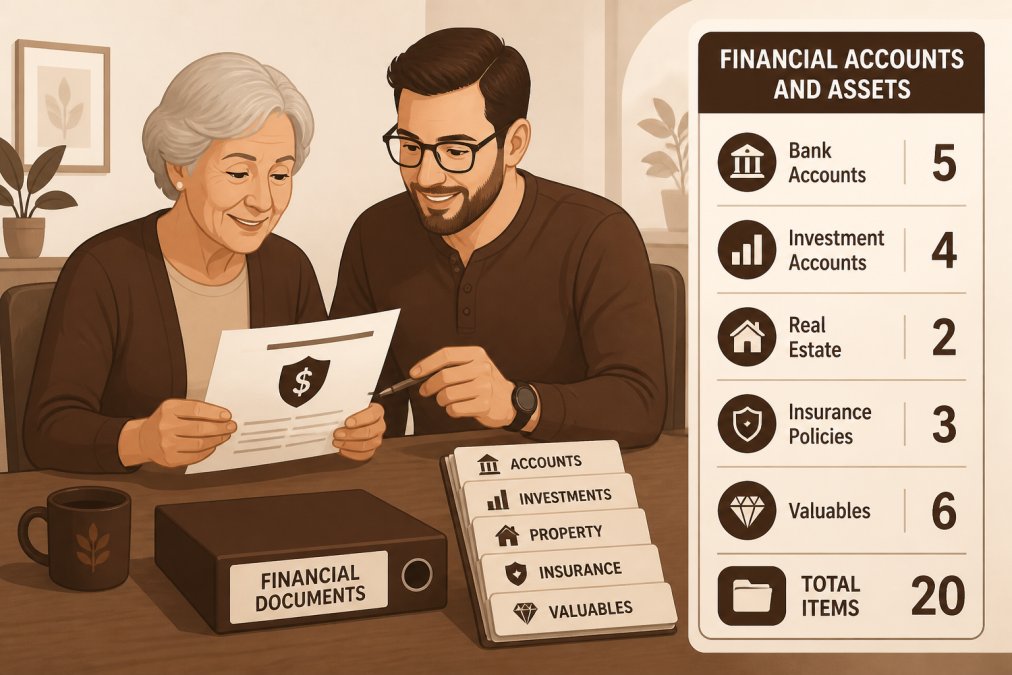
Your family needs a complete inventory of your financial life to avoid missing accounts or overlooking benefits they're entitled to.
List all bank accounts, investment accounts, retirement accounts, and other investments. For each account, include the institution name, account number, account type, approximate balance, and whether it has a designated beneficiary (which bypasses probate).
Document your pension or retirement income sources, including the plan administrator's contact information, your account number, and whether you elected a survivor benefit.
Create an inventory of all insurance policies, life, homeowners, auto, and other coverage. For each policy, include the policy number, insurance company contact information, coverage amount, and designated beneficiary. Life insurance proceeds go directly to the named beneficiary and don't pass through your will.
List your debts and liabilities: mortgages, car loans, credit cards, and other outstanding debts. Include the creditor's name, account number, approximate balance, and monthly payment. Your executor will need to settle these from your estate.
Include information about employer benefits if you're still working: health insurance, life insurance, stock options, or other benefits with survivor provisions. Include human resources contact information and your employee ID number.
Property Deeds and Titles
Real property represents significant value and requires specific documentation. Include copies of all property deeds and document how each property is titled, in your name alone, joint tenancy, or held in a trust. The way property is titled determines whether it passes automatically to a co-owner or through your will.
Include information about any mortgages or liens on your properties: lender's name, loan amount, interest rate, and monthly payment. Note whether you have mortgage life insurance that would pay off the loan if you die.
For investment properties, include information about rental income, property management companies, and tenant agreements. Document property tax account numbers and annual tax amounts so your family understands ongoing costs.
If you have a safe deposit box, document the bank name, box number, and key location. Note what you've stored in the box and include instructions on how your family can access it after your death.
Healthcare Directives and Proxy
Include your advance healthcare directive (living will) specifying your wishes about life-sustaining treatment, resuscitation, organ donation, and end-of-life decisions. Your family needs to know whether you want to be kept on life support and what quality of life matters most to you.
Document your healthcare proxy designation, the person authorized to make medical decisions for you if you're unable to do so. Include their full name, relationship, and contact information. Your healthcare providers need to know who has authority to make decisions.
Include any specific healthcare instructions beyond the standard directive. Do you have religious or cultural preferences about medical treatment? Are there specific treatments you refuse? Include a list of current medications with dosages, any allergies, and medical conditions healthcare providers need to know about.
Document your organ donation preferences and include information about your healthcare providers: primary care physician, specialists, and dentist with their contact information and your patient ID numbers.
Power of Attorney Documents
Include your financial power of attorney, which authorizes someone to manage your financial affairs, pay bills, access accounts, sell property, or manage investments. Include the agent's name, contact information, the document's date, and any limitations on their authority.
Document your healthcare power of attorney if separate from your healthcare proxy. Include the agent's name, relationship, and contact information.
Include a durable power of attorney if you have one, it remains in effect even if you become incapacitated. Note whether it's "springing" (takes effect only if you become incapacitated) or immediate.
Document any limitations or special instructions in your power of attorney documents and include contact information for the attorney who drafted them.
Digital Assets and Passwords
Your digital life requires the same attention as your physical life. Create a comprehensive inventory of all online accounts: email, social media, online banking, investment accounts, shopping accounts, and subscription services. For each account, include the username, website URL, and instructions for how your family should handle it after your death.
Document your passwords securely. Many people use a password manager like 1Password, which offers emergency access features allowing designated family members to gain access if something happens to you.
Include instructions for your email accounts, email is the gateway to other accounts and password resets. Document any cryptocurrency or digital currency you own, including the platform, account information, and instructions for your family.
Include information about cloud storage accounts (Google Drive, Dropbox, OneDrive, iCloud) and digital subscriptions. Note any digital legacy preferences for social media platforms that offer memorialization or legacy contact options.
Secure Storage and Accessibility
The most comprehensive legacy documents are worthless if your family can't find them. Choose a secure storage method balancing accessibility with protection. Many families use a combination: original documents in a safe deposit box, copies in a home safe, and digital backups in encrypted cloud storage.
Document your storage method clearly. Include the safe location and combination, the bank name and box number, or cloud service login information. Your executor and designated family members need to know exactly where to find your documents.
Create a master index or table of contents listing every document, what it contains, and where the original is stored. This index becomes the roadmap your family uses to navigate all the information you've left.
Consider using a digital legacy platform like My Living Legacy Course that provides a structured, guided way to pass down memories and instructions to future generations. If you choose a digital platform, include login information in your physical legacy documents.
Make sure at least two trusted people know where your legacy documents are stored. Tell your executor, a family member, and possibly your attorney the location.
Update your legacy documents regularly. Review them at least annually and update them whenever major life events occur.
Maintenance and Review Schedule
Legacy documents require regular review and updates to remain accurate and meaningful. Set a specific date each year to review everything and ensure it's still accurate. Check that account numbers are current, beneficiary designations haven't changed, and your wishes still reflect your values.
Update your documents whenever major life events occur: marriage, divorce, birth of grandchildren, significant financial changes, or major health changes. Don't wait for the annual review if something significant has changed.
Review your beneficiary designations on retirement accounts and insurance policies, these override your will. If you've experienced a divorce or significant family change, these designations may no longer be appropriate.
Check your digital account information regularly. Passwords change, accounts get hacked, and you may close old accounts or open new ones. Keep your digital asset inventory current.
Update your healthcare directives and power of attorney documents if your wishes change. Share significant updates with your family and executor so they understand your new wishes.
Consider having your documents reviewed by an attorney every few years. Laws change, and what was appropriate years ago may no longer be valid.
Frequently Asked Questions
What is the difference between a legacy document and a last will and testament?
A last will and testament is a legal document that designates who inherits your property and names an executor to manage your estate. Legacy documents are broader and more personal, including your life story, values, wishes, and instructions that go beyond legal matters. While a will focuses on asset distribution, legacy documents help your family understand who you were, your non-legal preferences, and guidance for decisions not covered by law. Many people use both together for comprehensive planning.
How do I write a legacy letter template that my family will actually read?
Keep your legacy letter personal and concise. Start with what matters most: your core values, life lessons, and messages to specific family members. Use a legacy letter template as a guide, addressing sections like your life story, family traditions, final wishes for celebrations, and advice for loved ones. Write in your authentic voice, conversational and genuine. Focus on emotional clarity rather than legal language. Many families find shorter, heartfelt letters more meaningful than lengthy documents. Consider organizing your thoughts into sections so readers can find what they need.
Should I include financial information in my legacy document?
Yes, but separate sensitive financial details from personal legacy documents. Create a detailed asset inventory listing bank accounts, investments, property, and insurance policies with account numbers and contact information. Store this securely and separately from sentimental legacy letters. Your last will and testament and power of attorney documents handle legal financial instructions. Your legacy documents can include non-sensitive guidance, like your values around money, wishes for charitable giving, or family financial lessons, without exposing passwords or account details to everyone who reads your story.
What is an ethical will and why should I include one?
An ethical will is a non-legal document where you share your values, life lessons, hopes, and blessings for your family. Unlike a legal will that distributes property, an ethical will communicates your beliefs and the principles that guided your life. It answers questions like: What matters most to me? What do I want my family to remember? What advice would I give? Including an ethical will ensures your children and grandchildren understand not just what you owned, but who you were and what you stood for, creating a lasting emotional and spiritual legacy.
Is a legacy document legally binding in the United States?
Most legacy documents are not legally binding. Personal letters, ethical wills, and digital legacy instructions are expressions of your wishes but don't have legal force. However, certain documents within your legacy plan, like your last will and testament, power of attorney, and advance healthcare directive, are legally binding when properly executed. For legal enforceability, work with an attorney to ensure documents meet your state's requirements. Legacy documents serve a different purpose: they provide clarity, comfort, and guidance to your family during difficult times, complementing your legal estate planning documents.
Creating comprehensive legacy documents requires thoughtfulness and organization, but the peace of mind it provides your family is invaluable. My Living Legacy Course helps you work through this process with guided modules and reflective prompts that ensure you capture not just the practical details, but the personal stories and values that make your legacy meaningful. Start organizing your legacy today, your family will be grateful you did.