 how-to
How to Interview Family Members for a Memoir
Last Updated: October 22, 2026
Quick Summary
How to interview family members for a memoir involves preparing beforehand by clarifying your goals and setting practical expectations, asking open-ended questions that prompt specific memories, and listening more than you talk to create authentic conversations. Record with permission using simple tools like a smartphone, then organize your recordings securely before weaving the stories into your narrative.
- Set 30 to 60 minute interview sessions in a quiet, comfortable location where your family member feels at ease.
- Ask specific sensory questions about early life, relationships, and challenges rather than generic questions about happiness or success.
- Pause for three seconds after your family member finishes speaking to encourage them to add details they almost left out.
- Use a simple template with 2-3 main topics and 5-7 questions per topic to stay organized without feeling rigid.
- Back up all recordings in at least two password-protected locations to preserve sensitive family stories securely.
Table of Contents
- Why Interviewing Family Members Matters for Your Memoir
- Prepare Before You Start: Setting Goals and Managing Expectations
- Family History Interview Questions That Uncover Real Stories
- Using a Family History Interview Template to Stay Organized
- Oral History Interview Tips for Deeper, More Authentic Conversations
- Recording Family Stories: Methods and Best Practices
- Turning Interviews Into Your Memoir: Next Steps
- Frequently Asked Questions
Why Interviewing Family Members Matters for Your Memoir
Capturing your family's stories while you can is one of the most meaningful gifts you can leave behind.
Here's what makes this work essential: family members often hold details you've forgotten, perspectives you never knew existed, and stories that bring context to your own journey.
The challenge is that many people approach these conversations unprepared. They sit down with good intentions, the conversation meanders, important details get lost, and both parties feel uncertain about what happens next.
Prepare Before You Start: Setting Goals and Managing Expectations
Before you record a single word, get clear on why you're doing this and what you hope to capture. Are you documenting family history? Preserving specific memories?
Start by telling your family member what you're working on. Be honest: you're creating a memoir, and their perspective matters.
Set practical expectations too. Agree on how long you'll talk (30 to 60 minutes works well for most people).
Family History Interview Questions That Uncover Real Stories
The right questions unlock memories that surface-level small talk never will. Good questions are open-ended, specific enough to guide thinking, and flexible enough to follow where the conversation naturally goes.
Questions About Early Life and Childhood
Start with the sensory details of how your family member grew up. These questions about early life often trigger a cascade of memories.
- What's your earliest memory? What do you remember about the place, the people around you, how you felt?
- Describe the house or apartment where you spent most of your childhood. What did it look like? Where did you play?
- What was your relationship like with your siblings (or cousins, if you're interviewing extended family)?
- Who was the most influential person in your childhood, and what did they teach you?
- What was a typical day like for you as a kid? What did you do before school, after school?
- Tell me about a moment when you felt proud or scared or embarrassed as a child.
- What did your parents value most? How did they show it?
These questions work because they ask for specifics, not "Was your childhood happy?" but "What do you remember about the house?" Specificity triggers real memory, not generic reflection.
Questions About Relationships and Family Bonds
Family relationships are often complicated and layered. These questions invite your family member to reflect on the bonds that shaped them.
- How did you meet your spouse or partner? What attracted you to them?
- What's something about your relationship with your siblings that people outside the family don't know?
- Describe a time when someone in the family really supported you. What did that mean?
- Have you ever felt misunderstood by someone close to you? How did you work through it?
- What's a family tradition or ritual that mattered to you? Why?
- Who in the family do you wish you'd gotten to know better?
- What do you hope your children or grandchildren understand about your parents?
These questions often surface vulnerability. That's where the real stories live, not in the highlight reel, but in the moments of connection, regret, or growth.
Questions About Work, Challenges, and Turning Points
Work and hardship reveal character. These questions help your family member articulate what they learned through doing and surviving.
- What was your first job, and what did it teach you?
- Describe a major challenge you faced and how you handled it.
- Was there a moment when your life changed direction? What caused it?
- What's something you're proud of that most people don't know about?
- Tell me about a failure or disappointment and what you learned from it.
- How did you make important decisions in your life? What was your process?
- What advice would you give your younger self?
These questions invite reflection on resilience and choice, the substance of a meaningful memoir.
Using a Family History Interview Template to Stay Organized
A simple template keeps you organized and ensures you cover the ground you want without feeling rigid. Here's a framework you can adapt:
Interview template structure:
- Family member's name, date, and relationship to you
- 2-3 main topics you want to explore
- 5-7 specific questions under each topic
- Space for unexpected tangents (the best stories often come here)
- Notes on what you want to follow up on in a future conversation
The template serves you, not the other way around. If a conversation naturally shifts to something meaningful, follow it. You can always return to your planned questions.
Many people find it helpful to write out their questions beforehand and have them on a note card or your phone. You don't need to read them word-for-word, but having them visible takes the pressure off remembering.
Oral History Interview Tips for Deeper, More Authentic Conversations
The quality of what you capture depends entirely on how you show up. Your presence, your listening, and your ability to stay curious transform a Q&A session into a real conversation.
Create a Comfortable Setting and Manage Your Own Nerves
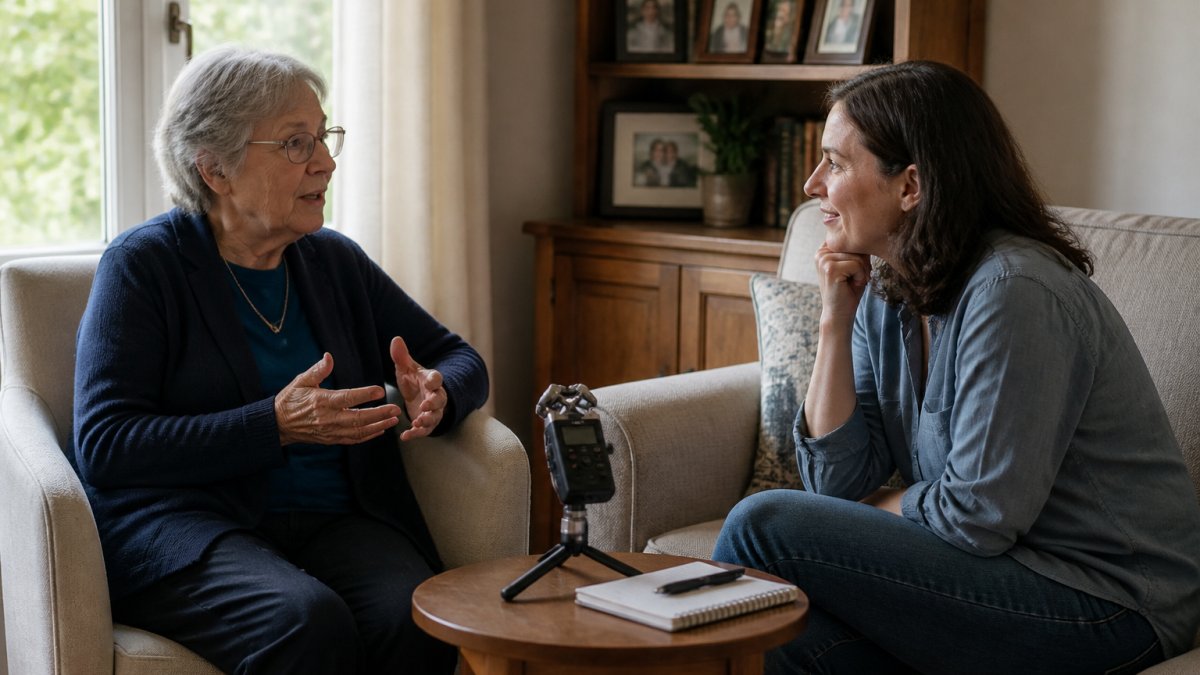
Environment shapes everything. Choose a quiet, familiar place where your family member feels at ease, usually their home or yours. Sit at a slight angle rather than directly across from each other; it feels less like an interrogation.
Your own nervousness is contagious. If you're anxious about getting it "right," your family member will sense it and become guarded. Remind yourself that this is a conversation between people who care about each other, not a formal deposition.
Listen More Than You Talk
This is the hardest part for most people. The impulse is to fill silence, to add your own memory, to correct something you think is inaccurate. Resist all of it.
When your family member finishes a thought, pause for three full seconds before asking your next question. That silence often prompts them to keep talking, to add detail they almost left out. It signals that you're genuinely interested, not just waiting for your turn to speak.
If your family member says something you remember differently, let it go. Their version is their truth. You're documenting how they experienced events, not fact-checking a Wikipedia entry. Disagreement about the past is normal in families, it's also rich material for a memoir.
Handle Disagreements and Sensitive Topics Respectfully
Some topics will be tender. Maybe there's family conflict you're both avoiding. Maybe your family member shared something they've never told anyone.
If tension arises, name it gently: "I notice we remember that differently.
Never push. If your family member says they're not ready to talk about something, honor that. You can come back to it later, or you might not.
Recording Family Stories: Methods and Best Practices
You have options for how to capture these conversations. The best method is the one you'll actually use consistently.
Audio Recording Options and Equipment
A smartphone voice memo app works perfectly well. You don't need expensive equipment. Most phones record clear audio in a quiet room.
If you want something slightly more strong, a portable digital recorder (around $50-100) gives you better audio quality and longer battery life. Brands like Zoom and Sony make reliable options.
Before you hit record, ask permission explicitly: "I'd like to record this so I can focus on listening instead of taking notes.
Organizing and Storing Your Recordings Securely
Create a simple folder system: one folder per family member, with dates in the filename. Label them clearly: "Mom_Interview_March2026.mp3" tells you exactly what you have.
Back up your recordings in at least two places. Keep one copy on your computer and one in cloud storage (Google Drive, Dropbox, or similar). This protects against losing everything if your device fails.
Consider privacy. These are intimate family stories. Store them somewhere password-protected, not on a shared drive.
Turning Interviews Into Your Memoir: Next Steps
Once you've gathered interviews, you have raw material to work with.
Listen back to your recordings. Take notes on the parts that stand out, not everything needs to make it into your memoir.
Consider how you'll weave these perspectives into your narrative. Will you include direct quotes? Paraphrase? Use family stories as backdrop to your own reflections?
This is where a structured program like My Living Legacy Course becomes valuable. It guides you through organizing not just interviews, but your entire life story and wishes.
Frequently Asked Questions
How do I get family members to share meaningful stories if they're reluctant to talk?
Start by explaining why their stories matter to you and your family's legacy. Share a personal reason, whether it's preserving family history, creating something for grandchildren, or simply wanting to know them better. Ask permission before the interview, send your questions in advance so they have time to think, and begin with lighter topics to build comfort. Many people worry they're boring or that their stories aren't worth recording; reassure them that everyday details and personal reflections are exactly what makes a memoir valuable and meaningful.
What should I do if family members remember the same event differently?
This is normal and valuable. Different perspectives reveal how people experienced the same moment uniquely. Record both versions respectfully without arguing over facts. In your memoir, you can acknowledge that memories differ, this actually adds depth and honesty to your family story. If a disagreement becomes tense, acknowledge the other person's experience and move forward: 'That's interesting, you remember it that way, and I remember it this way. Both are part of our story.' This approach honors everyone's truth and prevents interviews from turning into conflict.
How long should a family member interview last?
Aim for 45 minutes to 90 minutes for most interviews. Shorter sessions (30-45 minutes) work well if someone tires easily or is new to the process. Longer interviews (2+ hours) can work if the person is energized and engaged, but they often lose focus after 90 minutes. It's better to have two shorter interviews than one exhausting marathon session. Pay attention to energy levels and offer breaks. Always let them know the expected length beforehand so they can prepare mentally and physically.
How do I know if my family interview approach will actually help me preserve my legacy?
Structured interviews with prepared questions, organized recordings, and a clear plan to turn them into your memoir significantly increase the likelihood that your stories will be preserved and passed down meaningfully. Many families find that without this intentional process, stories fade or get lost. The key is consistency: schedule regular interviews, record them reliably, and commit to organizing and reviewing your material. Pairing interviews with a guided framework, like reflective prompts that help you contextualize family stories, can help you capture your legacy.
Interviewing family members for a memoir is an act of love. It honors the people who shaped you, preserves their voices for those who come after, and deepens your own understanding of where you come from. The structure and questions in this guide remove the guesswork. Start with one conversation. Listen carefully. Let the stories emerge. Your family, and your future readers, will be grateful you did.