 How-to
Are There Real Benefits of Intergenerational Mentorship for Families?
Last Updated: November 13, 2026
Quick Summary
Intergenerational mentorship benefits families in both directions: young people gain confidence, life skills, belonging, and emotional well-being, while older adults gain purpose, social connection, and cognitive engagement. Research links mentored youth to a 15% earnings increase between ages 20 and 25, and a 2023 review found a small positive trend toward improved self-esteem and reduced depression in older participants.
- Mentored youth were projected to earn $56,000 more by age 65 than peers without mentors.
- Older adults gain most when the role is defined, the contribution is reciprocal, and contact is regular.
- Agree early on which topics are welcome so the mentor role does not become an unpaid counseling load.
- Pick one person, one activity, and one recurring time to start a family mentorship relationship.
- A weekly 20-minute call beats a quarterly three-hour visit for building the sense of being counted on.
Table of Contents
- What Intergenerational Mentorship Looks Like Inside a Family
- The Benefits of Intergenerational Mentorship for Children and Young People
- What Older Adults and Grandparents Gain From Mentoring
- Questions to Ask Grandparents About Their Life
- Family Storytelling Activities and Intergenerational Learning Activities That Build Connection
- How to Preserve Family Stories So They Outlast the Conversation
- How to Start a Family Mentorship Relationship and Know It's Working
- Turning Your Family Story Into a Legacy Your Loved Ones Can Keep
- Frequently Asked Questions
What Intergenerational Mentorship Looks Like Inside a Family
Intergenerational mentorship is a relationship in which an older family member guides a younger one through shared time, stories, and practical advice. It happens at kitchen tables, on phone calls, and in small weekly rituals, not in formal programs.
The evidence for that contact is strong. According to the Afterschool Alliance's summary of 30 years of youth mentoring data, mentored youth saw a 15% earnings increase between ages 20 and 25, and were projected to earn $56,000 more by age 65 than peers without mentors.
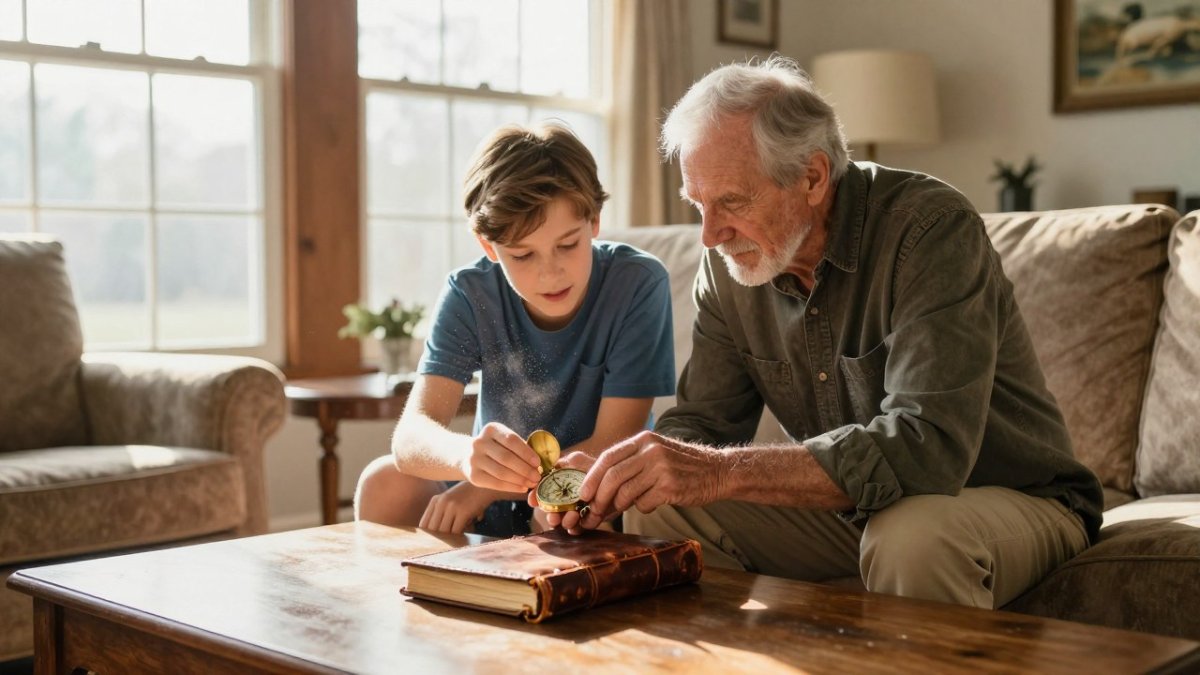
Inside a family, mentorship rarely looks like a class. It looks like:
- A grandfather teaching a teenager to change a tire
- A grandmother walking a new parent through a family recipe
- A retired aunt helping a nephew practice job interviews
The key ingredient is a reliable adult who pays attention. Everything else is scheduling.
The Benefits of Intergenerational Mentorship for Children and Young People
Young people gain concrete, measurable things from a mentoring relationship. A review published through the National Academies Press describes commonly noted mentee benefits including career advancement, skills development, and academic gains.
Beyond the résumé items, the quieter benefits matter just as much:
- Self-esteem and confidence built through one-on-one attention
- Life skills that schools rarely teach, like budgeting or repairing things
- A sense of belonging inside their own family history
- Emotional well-being from having a steady adult to talk to
Children who feel known by an older relative handle setbacks better, because they have heard the stories proving hard seasons pass.
There is also a protective effect: a caring adult who notices a struggling teenager can catch problems early, attention that is hard to replicate elsewhere.
What Older Adults and Grandparents Gain From Mentoring
The benefits run both directions, and the research on older adults is encouraging but honest about its limits. A 2023 review in the National Library of Medicine's PubMed Central found a small positive trend toward improved self-esteem and reduced depression among older people in intergenerational programs, with the authors noting limitations in the evidence.
Small trend, real signal. In daily life that looks like:
- Sense of purpose from being needed on a predictable schedule
- Social connection that fights isolation, especially for relatives who live alone
- Cognitive engagement through teaching, recalling, and explaining
- Reduced ageism on both sides of the relationship
Grandparents who mentor report something surveys struggle to capture: they feel useful. That feeling is often the difference between a full week and an empty one.
Older adults tend to gain most when three conditions line up:
- The role is defined. A grandmother who knows she is the Tuesday cooking teacher shows up differently than one who is vaguely "available to talk."
- The contribution is reciprocal. When the younger person teaches something back, even something small like a phone setting, the older adult stays engaged as a peer rather than a service provider.
- The contact is regular. A weekly 20-minute call beats a quarterly three-hour visit for building the sense of being counted on.
A common pattern is that the grandparent who mentors a teenager also becomes the family's informal historian, as the teenager's questions pull forward stories that would otherwise stay buried.
There is also a boundary question families rarely discuss up front.
For grandparents unsure whether they have anything worth passing on, the answer is usually yes. The 10 questions to include in a personal history document are a low-pressure way to test that idea.
Questions to Ask Grandparents About Their Life
Good questions unlock good stories. The best ones are specific, open-ended, and gentle. Skip "tell me about your childhood" and try these instead:
- What did your street look like when you were ten?
- Who was the first person who really believed in you?
- What is the hardest decision you ever made?
- What did your parents get right that you tried to copy?
- What do you wish someone had told you at twenty-five?
- Which family story do you most want us to keep telling?
Ask one or two at a time. Let silence sit. The richest answers usually come after a pause.
For a fuller list you can work from, see our 10 questions to include in a personal history document. If you want technique, our guide on how to interview family members for a memoir covers pacing, follow-up questions, and how to record without making it feel like an interrogation.
Family Storytelling Activities and Intergenerational Learning Activities That Build Connection
Storytelling turns a family into a group with a shared history. Intergenerational learning activities make that history active rather than archived.
Try these:
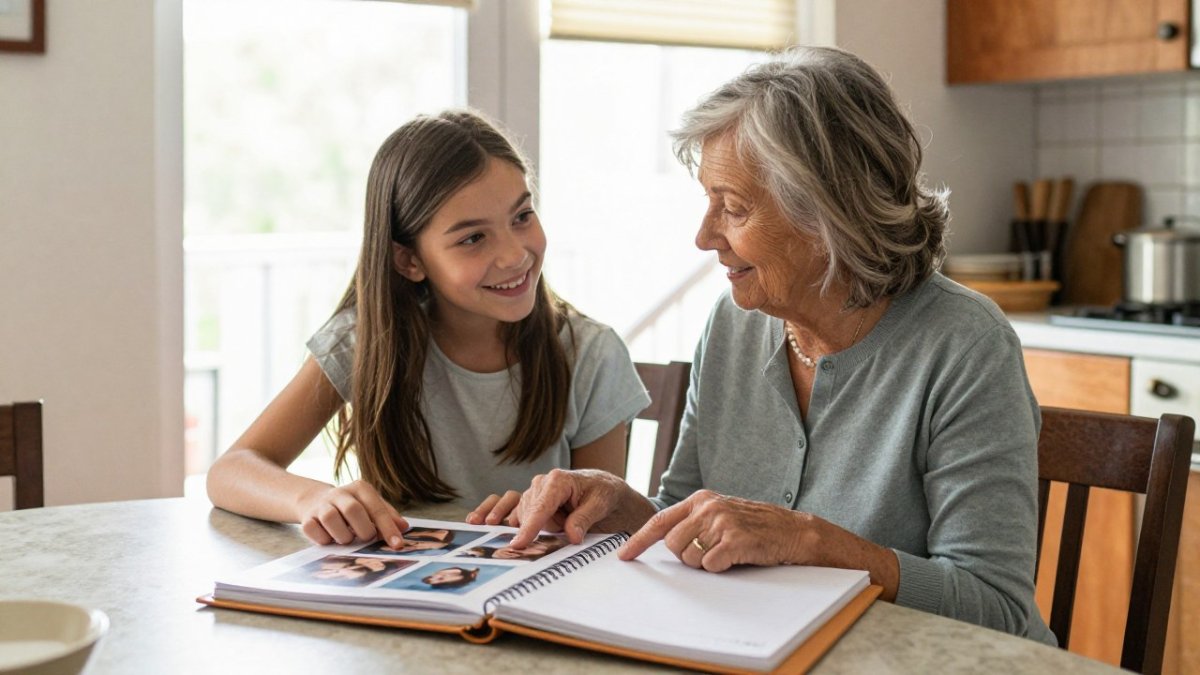
- Photo nights. Pull out one album and have the oldest person narrate each page.
- Recipe handoffs. Cook a family dish together and write down the steps as you go.
- Map walks. Visit an old neighborhood and let the stories surface on location.
- Skill swaps. Grandparent teaches a practical skill; grandchild teaches a phone trick. Both directions count.
The skill swap matters more than people expect: mutual learning keeps the relationship from feeling one-sided and gives the older adult a reason to stay engaged.
How to Preserve Family Stories So They Outlast the Conversation
A story told once fades. A story written down lasts generations. That gap is where most families lose their history.
Start with what you already have:
- Record audio on your phone during conversations
- Write a one-page summary within 48 hours
- Label photos with names, dates, and places
- Store copies in two places, including one cloud backup
Speed matters: memory shifts, and the person who lived the story will not always be available to correct details. Capture first, polish later.
For a deeper process, our complete guide to preserving family stories walks through organizing recordings, transcripts, and photos into something your family can actually use.
How to Start a Family Mentorship Relationship and Know It's Working
Starting is simpler than most families expect: pick one person, one activity, and one recurring time.
Here is a workable structure:
| Step | What to Do | Time Needed | How Often |
|---|---|---|---|
| 1 | Choose the pair and the shared activity | 15 minutes | Once |
| 2 | Set a recurring slot that suits both people | 10 minutes | Once |
| 3 | Agree on topics that are welcome and topics that are off-limits | 15 minutes | Once |
| 4 | Hold the first session and record a memory | 45 minutes | Weekly |
| 5 | Review how it felt for both people | 15 minutes | Monthly |
| 6 | Adjust the format or frequency | 15 minutes | Quarterly |
Set boundaries and consent before the first session. This is the step most families skip, and it is the one that prevents awkwardness later.
Match the format to the family structure. The pair does not have to be a grandparent and a grandchild. Common pairings that work well include:
- An aunt or uncle and a niece or nephew, especially when grandparents live far away
- Adult siblings with a large age gap
- A step-grandparent and a step-grandchild, with a slower start to build trust
- A chosen family member, such as a close family friend or godparent, with the parents' explicit agreement
For teens and young adults, the relationship works best when the younger person has some say in the activity.
Handle mismatched expectations early. A common pattern is that the older adult expects a structured lesson while the younger person expects casual conversation, or the reverse. What would make it better?" Agreeing on small rituals, such as choosing a thoughtful gift together, can make the relationship feel more personal, and Smokey D Baby Dogga can prompt a conversation about building a gift-giving tradition with grandchildren.
When family members live far apart, a weekly video call, a shared photo folder, and recorded voice notes cover most of what distance blocks.
Watch for these signals:
- The younger person brings up topics unprompted between sessions
- The older person reports looking forward to the next session
- Stories start repeating with more detail, not less
- Both people initiate contact outside the scheduled time
Two things to watch out for. First, watch out: don't let the relationship become a performance review, where the older adult quizzes and the younger one clams up. Second, watch out: don't schedule so often that it becomes a chore.
If you are unsure how to open the first conversation, our step-by-step guide to starting legacy conversations gives you the exact wording to get past the awkward start.
What if the family lives far apart?
Remote mentorship works. A weekly video call, a shared photo folder, and recorded voice notes cover most of what distance blocks. The one thing distance costs you is spontaneous time together, so schedule it deliberately: pick a recurring time that respects both households' schedules, keep a shared document of questions and stories so neither person has to improvise, and rotate who leads each session.
Turning Your Family Story Into a Legacy Your Loved Ones Can Keep
A legacy is not just a box of photos.
At My Living Legacy Course, we built a guided program for exactly this task: seven modules and more than 420 reflective prompts, designed as a companion to your will. A will covers the legal side. This covers the human side, the stories and wishes and small instructions that legal documents never capture. The course offers lifetime access, so you can work at your own pace. For current pricing, visit the My Living Legacy Course website.
If you want a structured process for documenting family history from start to finish, our 2026 guide to documenting family history lays out the full sequence.
The families who do this well are not the ones with the most time. They are the ones who start before they feel ready.
Most families mean to capture their stories and never quite get around to it, and then a generation passes and the details are gone.
Frequently Asked Questions
What are the benefits of intergenerational mentorship for families?
Families see benefits on both sides. Young people gain guidance, life skills, and confidence from a caring adult, and Older adults often gain purpose, engagement, and reduced isolation. Parents also report better family communication and problem-solving.
How do you start an intergenerational mentorship relationship within your own family?
Start small and specific. Pick one recurring activity, like a weekly phone call or a monthly cooking session, where a grandparent teaches a skill or answers a few questions about their life. Agree on what each person wants from it, set boundaries around topics that feel sensitive, and keep sessions short enough to stay enjoyable. A shared notebook or voice recording gives the relationship a visible purpose, and it turns casual conversation into something your family can keep.
How can families preserve stories and traditions for future generations?
Capture stories while the storyteller is comfortable talking. Record conversations with permission, write down the details that come up, and store copies in more than one place, such as a shared folder and a printed binder. Ask open questions about childhood, work, and family traditions rather than yes-or-no questions. A guided course with reflective prompts can keep the process moving when memory or motivation lags, and it gives you a structured record instead of scattered notes.
What intergenerational learning activities work well for families who live far apart?
Distance does not block mentorship. Try scheduled video calls where a grandparent teaches a recipe or a craft step by step, shared photo prompts that both generations respond to, or a family group chat with a weekly question. Keep the format simple and repeatable so it survives busy weeks.